The Mystery 💼 Dispatch
Updates on Carol's Books PLUS, if you love science blended with true stories, dark history, and twisted fiction, you're in the right place

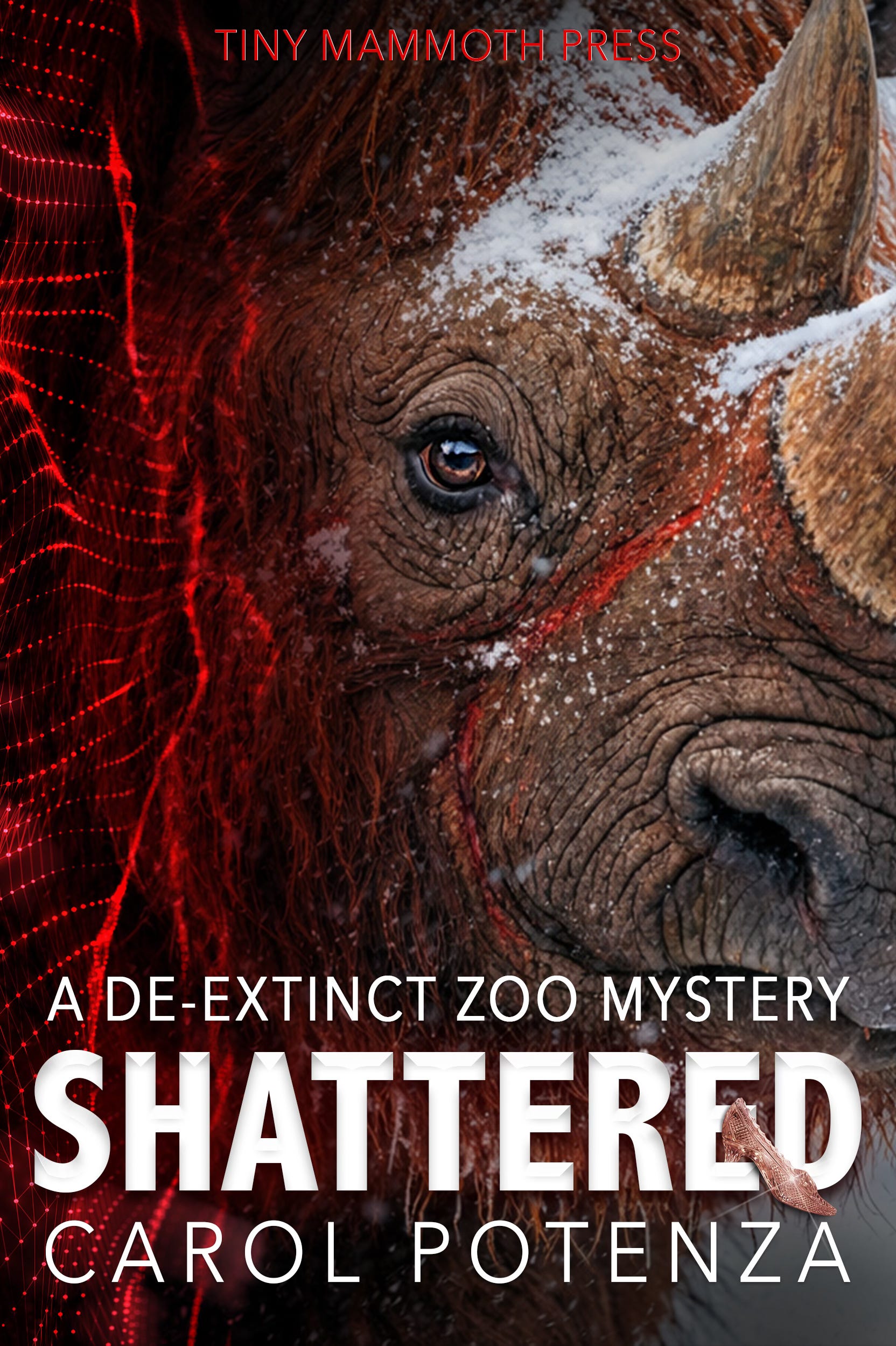
Shattered: A De-Extinct Zoo Mystery, Book 4 — so close …
The two quotes below embody the revision of Shattered and outlining the final De‑Extinct Zoo book in Milly’s story, Hunted, book 5:
“There are more things in Heaven and Earth, Horatio, than are dreamt of in your philosophy.” Hamlet, Wm. Shakespeare
“What has been will be again, what has been done will be done again; there is nothing new under the sun.” Ecclesiastes 1:9
On the surface, they contradict each other. Shakespeare gives us a world that’s too big for any single philosophy, too strange for tidy explanations. The second quote shrugs and says, “Relax. We’ve seen all this before.” Those two ideas sit right at the heart of the De-Extinct Zoo series.
I—ahem—borrowed the “bones” from a lot of other stories when I built the Pleistocene BioPark world, some you might recognize, some you might not. I’ve already written about that scene in The Poseidon Adventure (1972) I echoed in Ambushed, Book 3. Hunted will parallel another scene from the movie. What I still need to expand on is the ethical unease of The Boys from Brazil (1978), with its cloned boys and questions about nature versus nurture (all books in the De-Extinct series). There’s also a huge nod to the devastating deaths and desperation in Dean Koontz’s Nameless series—they were the model for this “shorter” interconnected series. In “real life,” Koko the gorilla and great ape sign language played a huge role in Signs, Book 2, as did Douglas Preston’s Jennie (1994), itself inspired by Meshie the chimp—that’s a difficult read, believe me.
None of these ideas is “new under the sun.” They’ve all been done, examined, and reviewed, and they all had a huge impact on me in weaving my stories.
But then you add something our grandparents absolutely did not see coming. Companies like Colossal Biosciences are actively working on de‑extinction—editing genomes, resurrecting traits from dire wolves, mammoths, dodos, and thylacines, and talking openly about rewilding ecosystems with animals that have been gone for thousands of years. That’s Horatio territory. His philosophy didn’t have CRISPR or venture‑funded startups pitching resurrected megafauna as climate tools.

Put all of that into a near‑future New Mexico Pleistocene BioPark, add resurrected mammoths and woolly rhinos, fold in oligarchs and succession games, and old tropes start behaving differently. Disaster set‑pieces, weaponized animals, engineered children and androids (Blade Runner, 1982 anyone?), plus transferred consciousness—classic story parts—wake up in a new “ecosystem” where de‑extinction science isn’t just speculative, it’s on the front page. The questions twist, too. Are we responsible for the animals we drag back from extinction because we can? (Hello, Jurassic Park, 1993). Are we responsible for the people we design because we chose their DNA? How much of ourselves is nature, nurture, or somebody else’s experiment?
So yes, there’s nothing new under the sun. I’m building Shattered and its siblings (heh) out of scavenged parts: classic disaster movies, ethical thrillers, ape-language research, and old myths about clones and monsters. At the same time, there are more things in Heaven and Earth than any one of those source stories could imagine. De‑extinction startups, AI, oligarch funding, re-wilded wilderness—our current reality gives my fictional BioPark teeth—and fur and scaled and claws ...
The De‑Extinct Zoo series lives where those two quotes overlap. I wanted these books to emerge from a place where the characters keep doing the same human things—grief, ambition, cruelty, love—inside worlds and inhabiting bodies that earlier stories never thought possible. And all the while, real scientists quietly work on giving my mammoths and rhinos a plausible path out of extinction and into our very messy future.
Publishing September 1, 2026

WORD of MOUTH: Camber
I love ancient history and prehistory and read whatever I can get my hands on. That’s how Eilmer of Malmesbury flew into Word of Mouth. This guy—with his own Wikipedia page, no less—was a medieval monk who strapped wings to himself, climbed the tower at Malmesbury Abbey around the year 1005 A.D. or so, and jumped.
William of Malmesbury wrote about Eilmer’s flight 100 years after the event:
‘In his early youth had hazarded an attempt of singular temerity: he had by some contrivance fastened to his hands and feet in order that he might fly as Daedalus … but agitated by the violence of the wind and a current of air, as well as the consciousness of his rash attempt’ …
… Eilmer “flew” about a furlong—roughly 200 meters—before crashing, breaking both legs, and blaming his failure on forgetting one crucial element: he forgot a tail.
But a word came up that I’d heard only in passing and never really thought about: camber. In aerodynamics, camber is the curvature or asymmetry between the upper and lower surfaces of a wing. A positively cambered wing has a more convex upper surface than lower—that means it “flies”.

This curve is one reason a properly shaped wing generates lift instead of just slicing the air. Who knows if Eilmer accidentally built any camber into his wings—probably not, since he didn’t exactly take off so much as glide until the ground, uh, intruded.
We can start thinking about human flight with the Greek myth of Icarus and Daedalus, but there’s also Archytas’s mechanical ‘pigeon’ in 4th‑century BCE Greece, which was said to fly 200 meters on steam. And there was Abbas ibn Firnas’s 9th‑century glider attempt in al-Andalus, and Leonardo’s 15th‑century wing sketches.
I myself once used a small Mary Poppins umbrella and a four-foot bank to try to fly. I was about 5 years old.
Yeah … It didn’t work.

Dump the next boring bestseller
Try a New Author
THE ALIBI CLUB by A.R. Northam

When a powerbroker is murdered in his penthouse, every suspect has a flawless alibi—and the proof to back it up. Detective Nora Flynn knows one thing: perfect alibis don’t exist. Someone at The Alibi Club is lying, and she’s going to tear their world apart to prove it.
MYSTERY AT MONROVIA CASTLE by Valerie Brandy

Dumped, fired, and rescued by a dream job in a storybook kingdom, Rebecca Orange thinks Monrovia—and its brooding duke—might be her fresh start. Then the castle’s architect turns up dead, and her best new friend is suspect number one. Fairy-tale life? Meet murder, secrets, and one very determined heroine.
PATINA AND POISON by Riley Hayes

Grand opening, new life … and a dead developer on the floor of her antique shop. Penny Goodwyn can read the emotional echoes on objects—and what she sees on a silver tray screams murder. In a town full of eccentrics and secrets, she’ll have to catch a killer before they catch her.
ECHOES THROUGH ETERNITY: THE LIVING BLOOD by Daniel Eroom

On the very spot where the last Templar Grand Master burned, a Vatican diplomat is found murdered—staged like a medieval execution, a Latin curse pinned to his body. Historian Gabriel Voss discovers the killings are tied to his own family and a secret Templar brotherhood that’s waited 700 years to collect a blood debt.
We are all inundated with “content,” and it can become overwhelming. Thank you for choosing to open my newsletter, read it, and my books.