
Tantalum, Trepanation (Trephination) or a Literal Hole in the Head, and the Periodic Table of DEATH and Mystery
If your curiosity is stronger than your caution, dive in and discover just how dangerous the building blocks of the universe can be ...

In January 1965, a Dutch medical student, Bart Huges, turned his bathroom into an operating room so he could operate on … himself. He used a hypodermic syringe full of a numbing agent on his own forehead, took a surgical knife, cut down to his own skull, then pressed an electric drill bit against the bone.
This reads like the start of a horror movie, but it’s true.
After a few minutes, he’d done what Stone Age healers, battlefield surgeons, and modern surgeons and medical specialists usually did on other subjects and patients. He’d performed a self‑trepanation (trephination), boring a five‑millimeter hole through his own head.
And get this. A few weeks later, when he had to go to the hospital, he was confined to the psychiatric ward, but they had to release him because none of the tests showed he had any mental illness. He had voluntarily and with purpose cut a literal hole in his head.
And, going forward, he convinced several other people to do the same thing. At the time (1960s), they called his followers a Trepanation Cult.

Glad there was no TikTok at the time. Forget Tide Pods—can you imagine?
Behind the horror‑movie facade, Huges believed he was doing precision work on human consciousness itself. His theory—“brainbloodvolume” (he wrote books about it)—argued that when humans stood upright, gravity stole blood from the brain, starving it of oxygen and glucose, and walling off the full, expansive awareness our ancestors once enjoyed.
He tried everything to reverse what he believed we’d lost. He:
Stood on his head for hours.
Experimented with LSD (That could explain A LOT).
Chased any state that made his skull feel less like a clamp.
But he became convinced that only a permanent physical change would work. By drilling a hole in his skull, he thought he was reopening the “expansion possibilities” of the cranium so each heartbeat could fully pulse into the brain again—no restrictions. He would be restoring a lost Eden of “subjective experience”. He would create … Homo sapiens correctus.
Huges saw himself as a pioneer—one cranial borehole away from unlocking the true potential of the human mind. But instead of a Nobel prize, he got a psychiatric hold.
All kidding aside, a generation earlier, other men with shattered skulls had put their lives in the hands of surgeons who were doing something just as radical—but with very different goals.
During World War II, military neurosurgeons were overwhelmed by head wounds from bullets, blast fragments, and helmets driven into bone. Unlike Huges, their patients hadn’t volunteered for a consciousness experiment. They were just young soldiers missing hand‑sized pieces of their skulls.
Saving them was only the first hurdle. Protecting their exposed brains for the decades they might live afterward was sometimes harder.
They needed a material to cover the healed wound that could:
be shaped quickly in an operating tent or a hospital surgical suite,
hold its form once implanted,
resist rust and corrosion in blood and cerebrospinal fluid,
and sit inside a human skull for years without provoking the immune system.
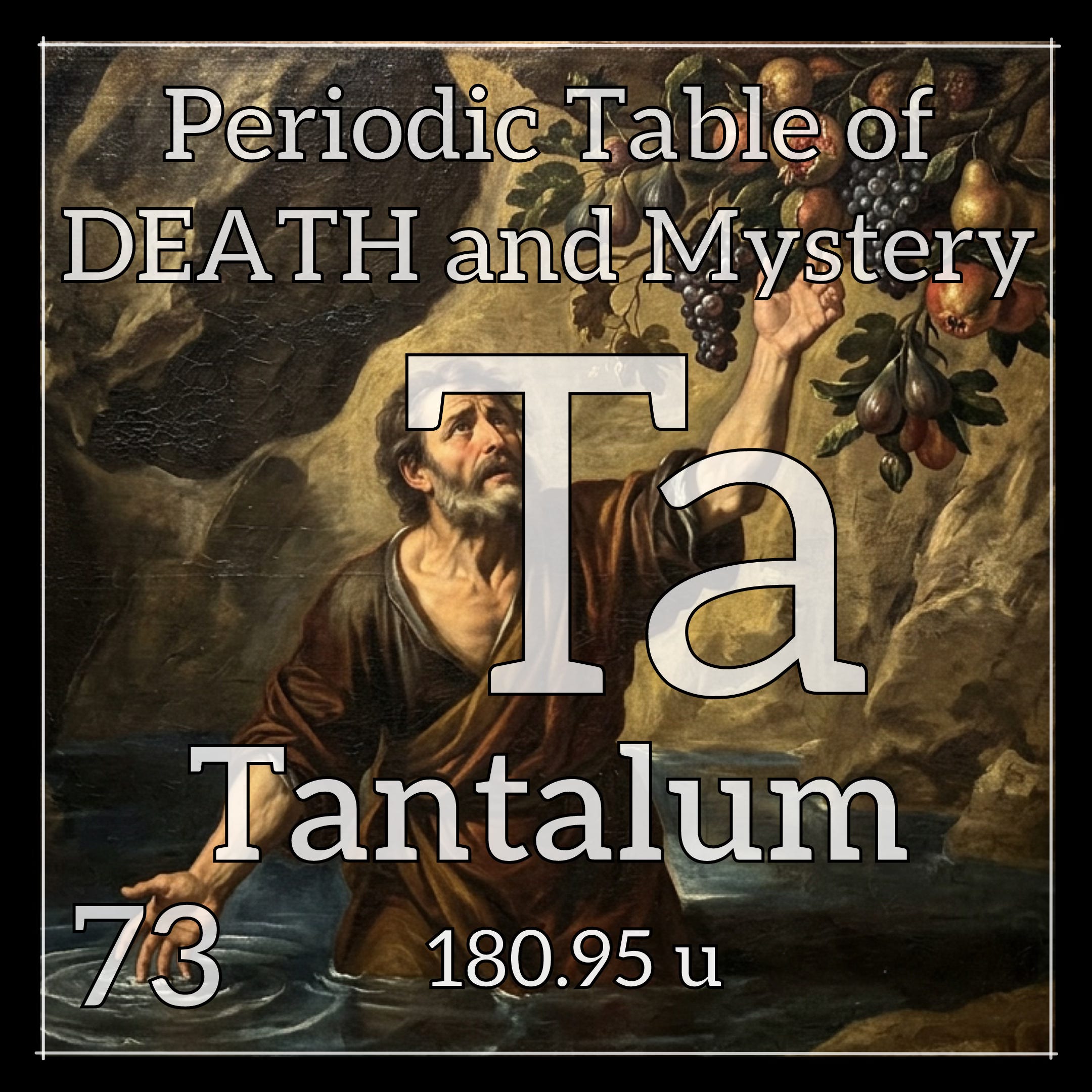
Enter tantalum—a dense, blue‑gray metal that had spent most of its existence as more of a chemical curiosity than a medical material. Tantalum (Ta), atomic number 73, atomic weight 180.95, is a Group 5, Period 5 transition metal. It’s malleable enough to be hammered into thin curved plates, strong and tough enough to resist deformation, and covered in a stable oxide (Ta2O5) that makes it remarkably corrosion resistant and highly inert in the human body.
Let’s chat about that before we proceed.
If you’re going to put a metal inside someone’s skull and leave it there for decades, you want something that behaves itself. Enter tantalum, named after one of the worst sons of Zeus in Greek mythology—Tantalus. Ugh. This guy.
Tantalus made every bad choice available to him. A stole the gods’ food, ambrosia. He betrayed their secrets. In one of the ugliest versions of his story, he killed his own son and served him to the Olympians as a test.
When the other gods caught him, they locked Tantalus up in the creative way only Greek gods can. After they resurrected the boy, they sentenced Tantalus not to death, but to be hungry and thirsty forever. He had to stand in water that vanished when he tried to drink, and under trees hanging with ripe fruit that lifted away when he reached. Surrounded by what he needed, eternally unable to touch it. Tantalized.
When Swedish chemist Anders Gustaf Ekeberg (who obviously had a Classical Greek education) isolated a new metal in 1802, he noticed its oxide refused to dissolve in the standard acids of the day—they swirled around it, but nothing “bit.” The element just sat there in the beaker like Tantalus in his pool—immersed, but unreachable. Ekeberg named it tantalum in honor of that punishment.
That immersed but unreachable turned out to be a blessing in the operating room. The same oxide layer that made tantalum so hard to dissolve in a lab made it almost impossible to corrode inside a human body. In World War II, when surgeons needed something to replace missing skull and just remain—quiet, inert, unreactive. Tantalum seemed the perfect choice.
Besides the lack of corrosion and low probability of an immune response, Tantalum also shows up clearly on X‑rays (it’s radioactive but in a good way), which, at the time, counted as a feature. Its half-life is 45 million billion years. The estimated age of the universe is ~14 billion years.
Wartime surgeons began shaping tantalum sheets into custom skull plates right on the table. They’d debride the wound, clear away bone and shrapnel, then lay a thin, curved tantalum plate over the defect and wire or screw it to the remaining bone margins.

The technique allowed one operation—cosmetic and protective repair—to save a life and shield a pulsing, vulnerable brain. Tantalum quickly became the preferred material for cranioplasty in both military and civilian settings, with more than a thousand such procedures performed during the war alone.
For a decade or so, if you survived a catastrophic head wound in that era, there was a good chance you went home with Tantalus’s metal hidden under your scalp, which stayed chemically unchanged as the rest of your body aged.
Huges drilled a hole in his skull chasing a subjective “high.” Wartime neurosurgeons cut bone away and slid tantalum into place, chasing something far more practical.
The chance for a damaged brain to keep on doing the quiet work of staying alive.
Biology and the continuation of the horror theme … 🦂
In New Mexico, scorpions are a feature AND a bug. We have small, almost transparent ones—probably the Striped Bark Scorpion (Centruroides vittatus)—that sneak into the house. And they are easy to step on—that’s why I wear shoes at all times.
The sting is a weird electric buzz, and the delivery method of its toxin is via a scimitar-curved tail barb. And a recently published paper has given us more details about the stinger: they are reinforced by METAL.
Which sounds like something out of a science fiction nightmare. Weaponized bugs.

Stingers tend to layer high amounts of zinc (Z) in their needle-sharp, curved tips, followed by a layer of manganese (Mn). But don’t forget the pincers! In the movable portion known as the tarsus, the research team found either zinc or a combination of zinc and iron (Fe) along the claw’s cutting edge.
Oh, Periodic table of elements! Is there nothing you can’t do?

Now, Roman antiquity and a great artifact for a horror story: The Mouth of Truth
Rome’s Mouth of Truth or Bocca della Verità is a massive round marble disk carved with a bearded face whose eyes, nose, and mouth are cut through. Today it sits in the portico of the church of Santa Maria in Cosmedin, not far from the ancient cattle market at the Forum Boarium.
The Mouth of Truth name and legend—put your hand in its mouth, and it’ll bite off the hand of a liar—show up in the late Middle Ages around 1485, when travelers started reporting it as a kind of public honesty test, especially for suspected adulterous wives. Why is it always wives? I know, but still.
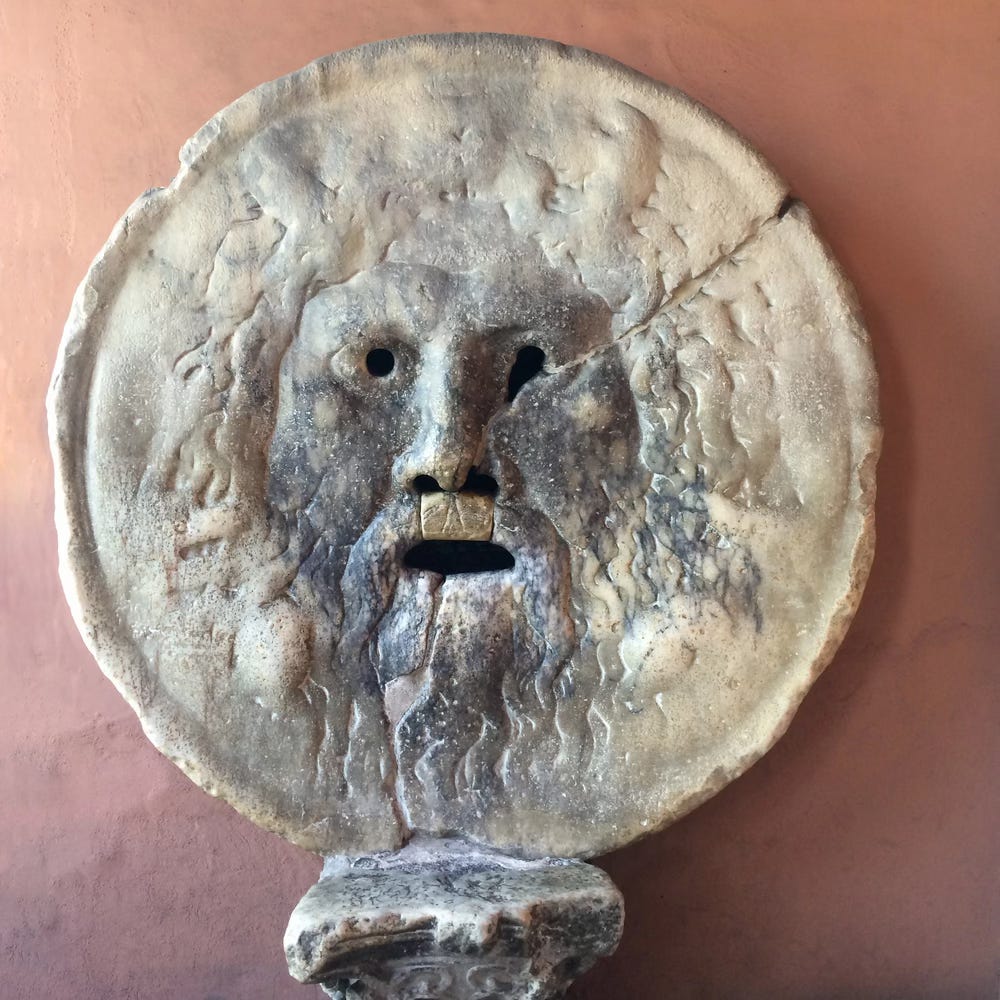
Its origins probably date back to the 1st century AD or BC, where the 2,900-pound marble mask was used as a drain cover in the Temple of Hercules Victor (for sacrifices of cattle), or possibly a manhole. Or a ceremonial well or fountain cover tied to water or river deities like Oceanus. The open mouth would have let water—or air—pass through, which is less glamorous than magically exposing liars but more useful in a city obsessed with drainage.
Oh. It was also used in Roman Holiday (1953) because the Audrey Hepburn and Gregory Peck characters were lying to each other all the way through the movie. Click on the movie title to watch it. It’s a great scene.
No hidden blade, no divine judgment—which is too bad because THAT would make a great horror story.
Thanks for getting all the way down!



You certainly know how to shock us with historic science experiments! I may have nightmares about this.
Well, that was fascinating and upsetting! I'm thankful scorpions are small. A metal-tailed six-foot (or bigger) insect is definitely the cause of nightmares.