
Sacred Ghosts: Changing the Past
A comment on writing the fourth book in the Nicky Matthews Mystery series

Sacred Ghosts is not an easy book to write—not because the words won’t come, but because of the difficult themes I need to weave through it.
There are a lot of threads, one of which is tied into the culture and traditions of the fictional pueblo where my protagonist works, her feelings on justice and equality, and how they collide.
It’s a balance to show both sides of a much larger argument about past history, how it intersects with the present, and how to carry that burden through to the future.
The premise of the book is this (and it could change): A non‑Native tribal cop who loves her adopted community must investigate a series of crimes rooted in stolen history and political betrayal, and ultimately choose between keeping her badge or staying true to her own sense of justice.
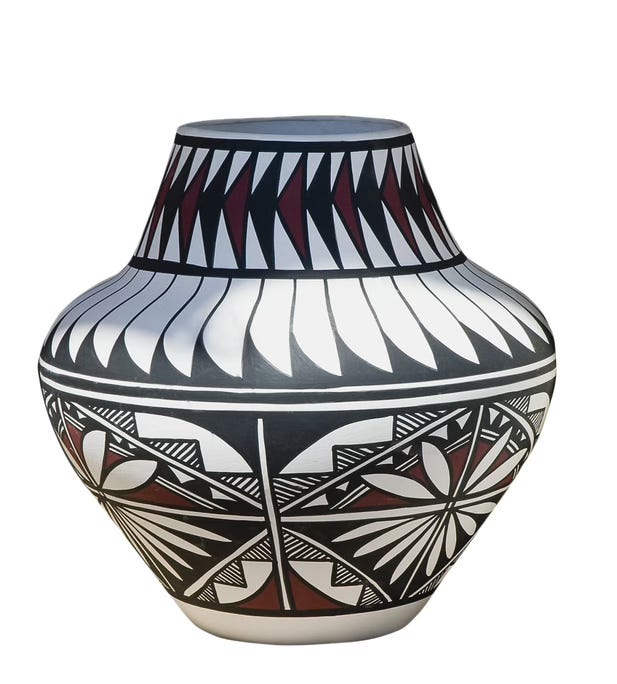
So let’s metaphor this out in clay because I have some beautifully painted Native American pottery sitting in my home.
The past is like fired clay.
The shape is set, the surface hardened. It would be nice to change it—but you can’t.
What you can change is what the past means in your life.
Every regret, every mistake, every loss is raw material you don’t get to discard, but you can repurpose it. You can’t rewrite what happened, but you can decide whether it becomes a weight that drags you down or a base you build on. The same event can be a wound you keep poking at, keep making bleed, or a scar that teaches you where your limits are and how far you’ve come.
That’s what “working with what you have” really is.
It’s NOT passive acceptance, but active craftsmanship. You take your current self—your history, your skills, your damage, your loves, your sorrows, your regrets—and you ask, “Given all of this, what can I do next?” Not “What should I have done then?” but “What will I do now?”

The future, unlike the past, is still soft clay.
When you focus on shaping your next decision, your next conversation, your next small act of bravery (like hitting “publish”) or kindness, you’re quietly changing the only part of time that ever responds to pressure.
Over and over, those choices accumulate into a life that, if not free of regret, is at least not ruled by it. Deep, huh?
You don’t get a different past. You do get an evolving present, and a future that’s constantly being shaped out of it. The work is to stop arguing with the vessel you’ve already fired and start learning what you can still make with the soft clay that’s left in your hands.