
Potenza's Periodic Updates: Iodine, Murder in a World War I Field Hospital, and the Periodic Table of DEATH and Mystery, Part II
If your curiosity is stronger than your caution, dive in and discover just how dangerous the building blocks of the universe can be ...


Poisons
About me …
I give a lot of presentations to writers on poison. Apparently, if you have a biochemistry background and a slightly unsettling enthusiasm for symptoms and cellular damage, people assume you’re the go‑to for how to add poison to your plots. As you might suspect, this side hustle grew out of the Periodic Table of DEATH and Mystery. I’ve already done a couple of talks this year for different writing groups and am always open to more.
One was about Mad Honey—made with nectar from rhododendron flowers loaded with grayanotoxins, a neurotoxin that can drop your blood pressure and scramble your brain in record time. There’s some great history tied to Mad Honey that nicely parallels the cliché If it looks too good to be true … Kind of the original definition of “Honey Trap.” (see: Roman Empire—What NOT to do).
I just did an “Ask the Expert” session for the Kiss of Death writing group, where the questions were disturbingly specific in a way that warmed my heart. I’m also putting together a talk for the Romance Writers of America conference this summer in Albuquerque about using poison in romance—because, if you actually peruse the genre, people are poisoning each other for love (or lack thereof) uncomfortably more than you’d think. Nothing says “happily ever after” like checking your coffee for arsenic.
Is it wrong of me to enjoy this subject so much? It is? Let’s go out for a cup of coffee and discuss ….

Word of Mouth: Ostracon (plural: ostraca)
Ostraca were pieces of broken pottery reused to write little notes or draw or paint pictures—kind of like the way we use the back of discarded printer paper. The interesting thing about these ostraca in ancient times is that they weren’t “formal.” It was the everyday writing about whatever—Simon was here, Vote for Prometheus, Bring home a quart of goat milk. It gives archaeologists insight into the lives of everyday people, not just the elites.
I found this word of mouth while researching the history behind the streaming show, House of David (Amazon Prime, I think). It brought up questions that let me rabbit-hole, one of my favorite forms of internet exercise. There is practically no archaeological evidence that the Biblical David existed (the Tel Dan stele?)—but check out this ostracon from Khirbet Qeiyafa.
Writing Updates:
Shattered
I am 53.74% through revision of Shattered: A De-Extinct Mystery, book 4—give or take. The second half of the manuscript is more difficult to revise because I have to knot the threads from the first half to a satisfying conclusion. It’s really shaping up, and the ending is SHOCKING! *shiver*


Sacred Ghosts
I’ve re-read and finished a fairly heavy revision on the first (of 4) act (24k words) of Sacred Ghosts: A Nick Matthews Mystery, also book 4 in its series. I wrote ~2/3rds of the book a few years ago and put it aside for other projects (Sting of Lies, Echo of Lies, Signs and Ambushed, Author Survival Guide).
Confession: I think I was reluctant to finish it because—at the time—this was the last book in this series, and it made me sad. Maybe that’s why some authors write TOO MANY books in certain series. They just don’t want to let their characters go when it’s time.
Like the Harvey Dent quote from Batman: The Dark Knight
"You either die a hero or you live long enough to see yourself become the villain."
Maybe not a villain exactly, but sometimes it feels like your hero ultimately ends up shaking their fist and yelling incoherently at the sky. Now that’s sad.
Then late last year, I came up with a fifth book plot and outlined it and LOVED it. So the sadness about SG turned happy, and I’m chugging along, changing complicated to complex, and highlighting themes and subplots.
For example:
The Pre-Columbian dogs subplot and Howard’s story (girlfriend for real): “They’re after the dogs—the real sacred ghosts of this mesa. I’m on guard. I’m supposed to protect them.”
Does Pep Katina betray and turn Nicky in because of a stolen artifact? (red herring?) Pep’s mouth pinched. “Leave it be, Sarge.”
Stay tuned for more possible hints and spoilers!
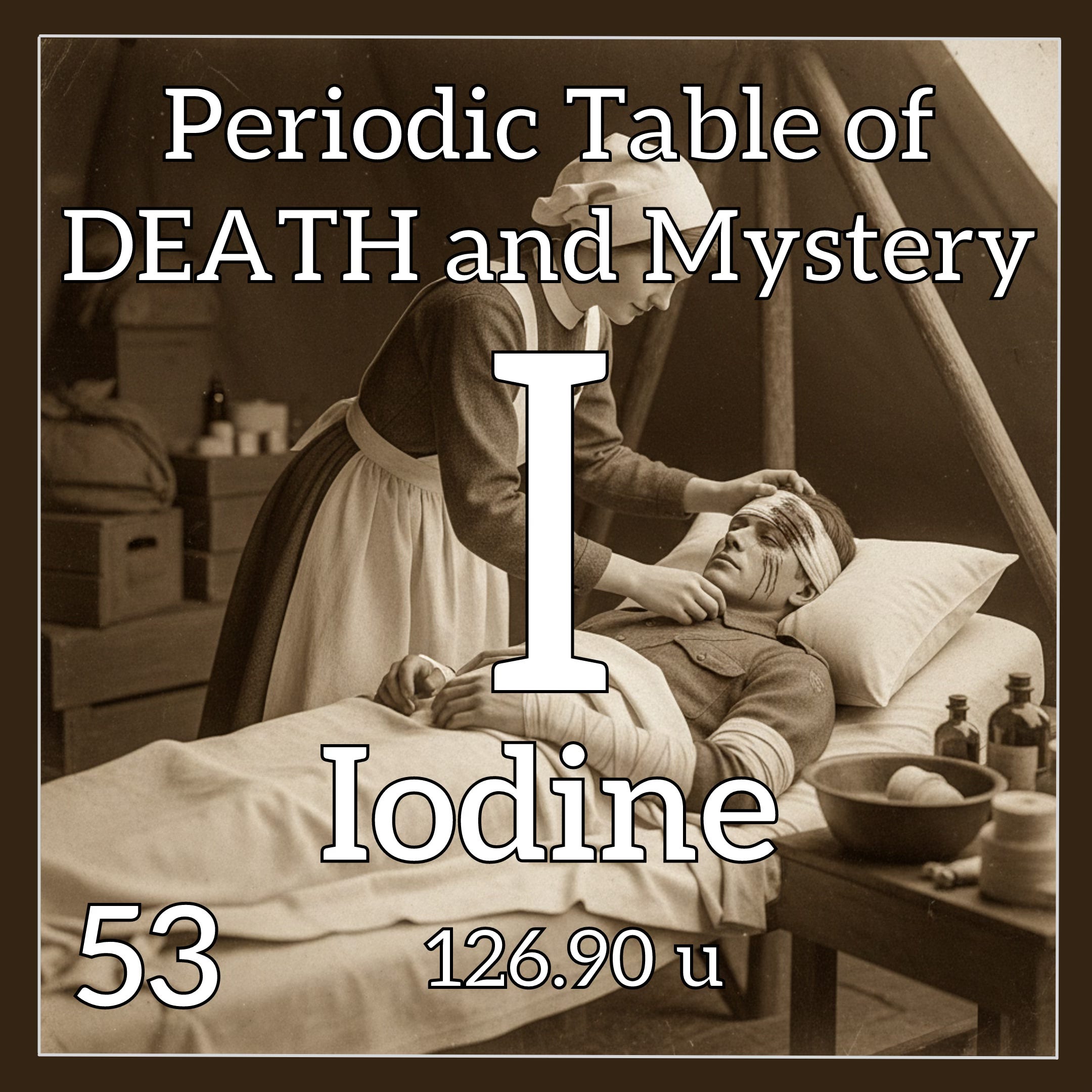
Iodine, Murder in a World War I Field Hospital, and the Periodic Table of DEATH and Mystery, Part II
Spring, 1920
London
III. Chemistry and Courage
‘The next afternoon, while he was in surgery, I examined Ward C’s tincture of iodine supplies. The bottles looked ordinary enough—amber glass, glass stopper, the usual military label: TINCT. IOD. 5% IN ALCOHOL.
‘I opened it. The iodine reek made my eyes sting. The color was dark, almost blood red, where it clung to the glass.
‘You gentlemen will know that our standard tincture is weaker than its label suggests—about two percent iodine with a little iodide in alcohol. Strong enough to kill bacteria, not so strong as to poison a man through intact skin.
‘I had learned to judge concentration by color and smell, by how a drop blooms in water. Every bottle I tested behaved as it should.
‘To be sure, I took a small, secret sample in a clean vial. Later that night, in the tiny dispensary room where we mix poultices and powders, I did what I could without a laboratory. I diluted it, compared its color against the standard bottle, and dabbed a drop on my own forearm. The sting and stain were ordinary. This iodine would sear germs, not souls.’
“Sister, what are you doing?” the night nurse asked, stepping in.
“Testing a batch from pharmacy,” I said lightly. “I was worried it may be too strong.”
“Too strong? Oh, not this.” She smiled. “The Major keeps the stronger batch in his quarters.”
“He does?” I said. “Why?”
“For the boys who come in with bad sepsis. You didn’t know? He keeps logs of the outcomes. I—I’ve seen them.” She then blushed very red. “You won’t … you won’t tell him I said so?”
“Of course not,” I said. “Go on. I’ll finish here.”
‘When she had gone, I put the bottles back as they were. There was nothing in pharmacy I could condemn. The dangerous tincture, if it existed, was in Major Haviland’s sleeping quarters.
‘I had no right to enter a senior officer’s quarters. And I had every belief that the nurse who adored him—whose patients kept dying on her watch—would warn him of any woman who tried.’
“This night nurse—” one of the majors on the dais began.
‘Sister Evans, sir.’
“She was … close to Major Haviland, you say?”
Two other officers exchanged the faint, knowing smiles of men who forgive each other outside marriage dalliances.
The presiding officer furrowed his brow. “Why is she not before us as a supporting witness?”
‘Because she’s dead, Colonel.’
The sly smiles vanished.
‘She was transferred to a casualty clearing station nearer the line two days after I spoke with her. That station took a direct hit from artillery. There were no survivors.’
They weighed my words as if I were the one in the dock. So be it.
‘In the Bible, King David sent Uriah to the front to tidy away an inconvenience. I cannot prove Major Haviland had the same clarity of purpose. I can only note that the one person who could have confirmed his stronger tincture and his private outcome logs was removed to the most dangerous post available and was killed almost at once.’
IV. The “Septic” Soldier
‘The man who forced my hand was Sergeant Hugo Brandt. You have his file, I believe. Shell fragment to the shoulder. Large but clean wound, debrided promptly, no foreign material left inside the body. No signs of gas gangrene, no foul smell.
‘His face—if one were inclined to see evil in features—was rough. Heavy jaw, big nose, brows that hung low over his eyes. He had been a dock worker before the war, and his hands looked like he could crack walnuts between his thumb and forefinger. He also wrote poetry, which he recited shyly when the ward was quiet.
‘Haviland did not like him.’
“Troublemaker,” I heard him say to Captain Marsh. “Look at the forehead. The jaw. And he doesn’t make eye contact. These types rarely do.”
“He writes poems about his mother,” I said before I could stop myself. “Hardly the stuff of a troublemaker.”
Haviland turned slowly toward me. “You are very free with your opinions, Sister.”
“Chemistry teaches one to distinguish between cause and coincidence, sir,” I said, cheeks hot. “Four unexplained deaths in your ward seem to lean toward … cause.”
The silence between us was heavy as a Black Maria.
“I would be very careful,” he said softly, “not to suggest impropriety where none exists.”
‘That night, Brandt’s dressing was due for a change. I arranged the schedule so that I would be present, not because I distrusted the other nurses, but because I needed to see exactly what was done.
‘Haviland arrived with his usual unhurried stride, carrying a “special” bottle.’
“Evening rounds, Nurse,” he said. “Let us see how our poet is faring.”
Brandt smiled weakly. “Evenin’, Major.”
“Any pain?” Haviland asked.
“Only when the shell remembers me, sir,” Brandt said. “Otherwise, I feel fine.”
“Good,” Haviland said. “We’ll keep it that way.”
He removed the dressing himself. The wound was pink, with a thin yellowish film of normal healing exudate. No redness, no swelling beyond the expected. No foul odor.
“Very clean,” I said, deliberately neutral.
“Ah. Thank you for your … opinion, Nurse,” he said. “One must never be complacent. Microbes are invisible. Character, however…” He tilted his head, studying Brandt’s face. “Character shows itself.”
Brandt flushed and looked away.
Haviland uncorked the special bottle. The iodine fumes rushed out, acrid and overpowering.
“Let me prepare a diluted solution, sir,” I said, taking a step forward. “This seems particularly—”
“That won’t be necessary,” he interrupted. “Deep wounds require a strong hand.”
He poured the tincture liberally over the wound. Brandt gasped, teeth gritted, knuckles white on the sheet.
I looked down at my hands, fighting the burn in my eyes, the thickness in my throat.
‘I should have stopped him.’
But I am determined to be clear-eyed and professional, not to give the men on the dais any reason to write off my testimony as that of a hysterical female. I lift my chin and continue.
“Breathe, Sergeant,” I said, taking his free hand. “In and out. It will pass.”
I watched the iodine soak into the wound—too much, far too much, a brown-black tide.
‘After Haviland left, I remained by Brandt’s bed longer than duty strictly required. I counted his pulse every half hour. Seventy-two. Seventy-eight. Eighty-five. A little elevated from pain, perhaps, but nothing alarming. I so hoped …
‘At midnight, I was with Private O’Mara at the far end of the ward when I heard the rattle.’
“Brandt,” I said under my breath.
By the time I reached him, his body was shaking violently, and his skin was filmed with sweat. His heart had doubled its pace.
“Not again,” one of the orderlies whispered. “God, not again.”
“Fetch Captain Marsh,” I said. “Now.”
We checked his temperature. Ninety-eight point eight. His wound—still clean. But his pupils were wide, his hands fluttering, his breath shallow.
“Feels like my heart will burst,” he panted. “Sister—please—”
I gripped his hand harder, though my own fingers shook. “You’re not going anywhere, Sergeant Brandt. Do you hear me? You stay right here.”
Marsh arrived, glance already wary.
“Septic—” he began.
“Sepsis without fever?” I said sharply. “Without a discolored wound? Look at him. Listen to his heart. It’s like a bird trapped in a box.”
“We’ve seen this before, Sister,” Marsh said. “We must accept—”
“This is iodine intoxication, Captain,” I snapped. “I read a case description years ago—a man drank tincture in a suicide attempt. The symptoms were the same. Tachycardia. Tremors. Delirium. Cardiac collapse.”
“How could iodine through the skin—”
“Through a compromised wound surface. Through an overdose.”
Brandt cried out. His back arched. For a moment, I thought his ribs would shatter under the force of his heart. Then, suddenly, he sagged.
I knew that sag.
“No,” I whispered. “No, no—”
‘He was dead before Marsh could respond.’
V. The Courtroom
‘And so we come to why I stand before you today.
‘I reported my suspicions first to the matron, who clucked her tongue and told me I had a vivid imagination. Then to Captain Marsh, who looked afraid. Then, finally, to Colonel Beecham, commanding officer of the medical unit.
“These are serious accusations, Sister. Do you have proof?”
“I have patterns, sir,” I said. “I have seen a bottle of tincture used only by Major Haviland on men whose skulls and faces fit his theory of criminality. I have charts that show no fever, no infection, and sudden cardiovascular collapse following heavy topical application.”
“Patterns are not proof,” he said. “But they may warrant investigation.”
‘You gentlemen are that investigation.’
They sit at the long table, uniforms neat, pens ready. They thank me. I am excused. I move to a smaller table, my hands folded to hide their trembling.
Next, a clerk reads out the pharmacy requisitions. It took some time to find a copy, but only the Romans were more pedantic than we Brits about documentation: a request signed by Haviland for “concentrated iodine tincture for deeply contaminated wounds,” filled by a supply depot in England that had not yet updated to the safer, diluted formula. They murmur over that. Some of them nod.
Haviland sits at the opposite table, composed and elegant, flanked by the officer assigned as his counsel. He watches me with mild interest, as if observing an insect.
When it is his turn, he rises smoothly.
“I am not ignorant of iodine toxicity, gentlemen,” he says. “I am not a barbarian. I requested stronger tincture because we deal with filthy shrapnel wounds. If we under-sterilize, men die of gas gangrene. If we over-sterilize … well, Sister O’Donnell has spun a fascinating tale about murder by antiseptic.”
There is a ripple of strained amusement.
“I will not deny that I have an interest in the emerging science of characterology,” he continues. “I have read Lombroso. I have spoken impolitic words about skull shapes and predispositions at mess tables. For that I apologize. But to leap from that to the accusation that I deliberately killed my own patients—our brave soldiers—is … extravagant.”
He spreads his hands. “What motive would I have? What benefit? These men were already under my care, already wounded. Why should I wish them dead?”
I could answer that. I could speak of the gleam in his eyes when he described preemptive justice, of the satisfaction of “pruning” the human tree. But that is speculation. And speculation is not enough.
“Sepsis presents in many ways,” he says. “The Sister herself admits we lack a full laboratory. We cannot culture organisms. We cannot see the invisible. To label these tragedies as ‘murder’ because they do not fit a textbook, and because a nurse with a chemistry hobby finds the smell of one tincture stronger than another …” He shakes his head. “I trust you will weigh her enthusiasm against my years of experience.”
You questioned me. Now, question him. Examine the requisitions, the sample bottle sent as evidence, the charts. Don’t take his word, I beg you.
Will you find Major Haviland guilty or not?
Read for The Verdict on my new website.
This is a fictional story that uses history and iodine to narrate an elemental murder and mystery.
Thanks for reading down this far! I’d love comments and Questions.
Some of the best, most original books out there are independently published, so ...

I love the witty humor you bring to a clever mix of poison, history and murder.
Great article! I loved learning more about iodine. I hope to get to your talk at RWA!