Potenza's Periodic Updates: Iodine, Murder in a World War I Field Hospital, and the Periodic Table of DEATH and Mystery, Part I
Once a wounded soldier reached a hospital, general survival rates were high - 95-98%. Unless what met them wasn't care, but culling ... and medicine was used for murder. ...
I’ve flipped the PToDM newsletter this month to start with the periodic table element. There’s a lot of good stuff after it, including the mating habits of Neanderthal men, a sneak peek at the new Shattered cover, and one of my books that complements Women’s History Month. —Carol
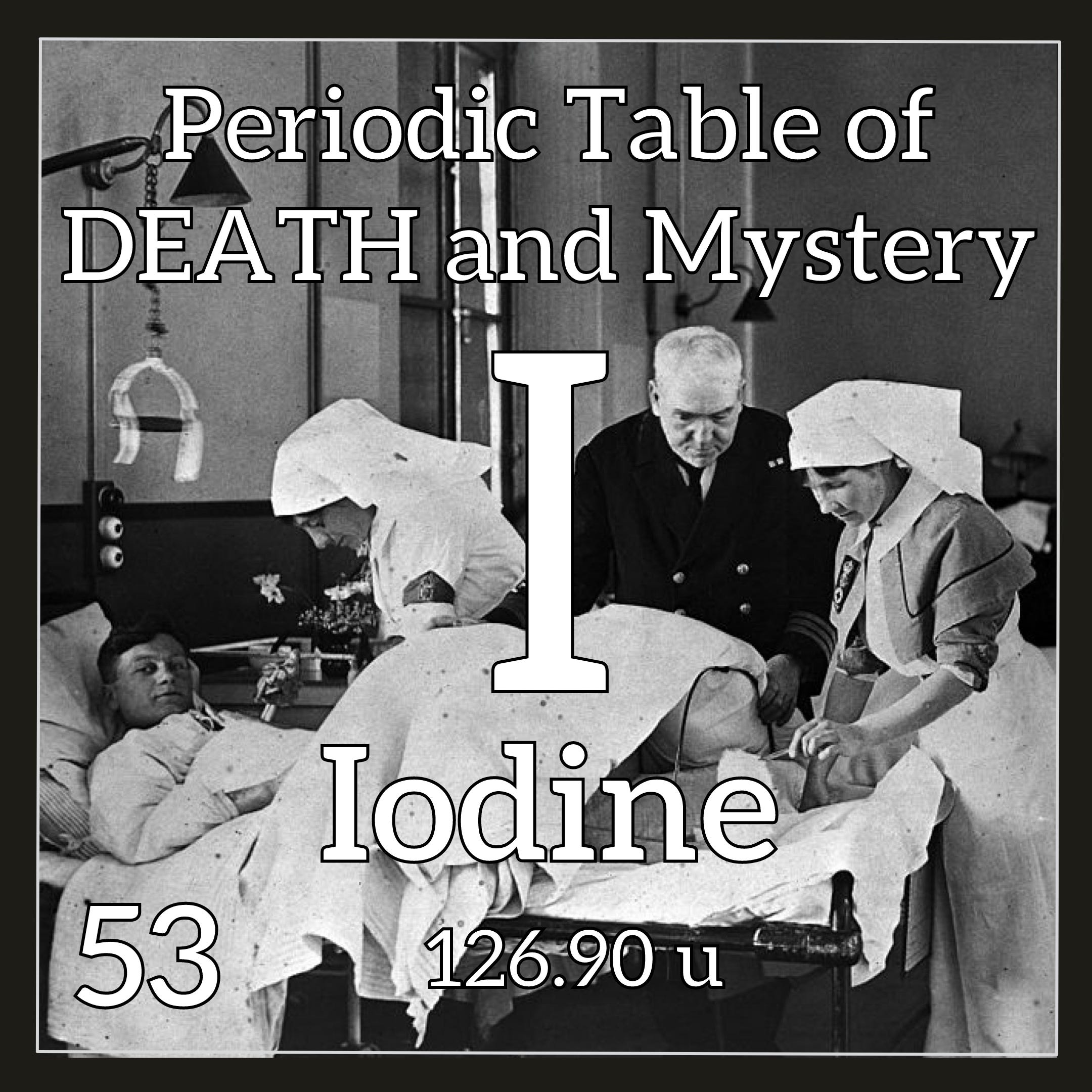
Iodine, Murder in a World War I Field Hospital, and the Periodic Table of DEATH and Mystery, Part I
Spring, 1920
London
Testimony
“The first time I saw a man die from iodine overdose, he thanked the doctor with his last breath, gentlemen.
“You ask for my account of the deaths in Ward C of the -X- Field Hospital, and why I believe they were not septic shock. I will tell you everything I know, and everything I can prove—and then you may decide whether to believe a nurse with a chemistry degree she is not allowed to use, or an esteemed surgeon with medals on his chest—the man who murdered them.”
The courtroom exploded as if I’d thrown a live grenade. The clerk fumbled his pen, and two officers on the dais shifted to mutter in each other’s ears. The defense officer blustered, “So, you have already judged the Major guilty before we begin, have you, Sister? This is what we get when we put hysterical women in the witness chair.” Over him, the presiding officer snapped, “Sister, you will refrain from such language in this court and will withdraw that accusation at once.”
Good. If they were offended, they were listening. I folded my hands and straightened. These men needed to understand that what I was presenting was not negligence, but premeditation.
When the murmurings died down, the presiding officer pinned me with his eye. “The word ‘murder’ will not be used again unless this court finds it proven. Until then, you will confine yourself to facts, Sister. Continue.”
And yet he’d just repeated the word: Murder. I was satisfied for now.
Nodding my head in acknowledgment. When the scratch of the clerk’s pen stopped, I said,
“My name is Sister Susanna O’Donnell, V.A.D. nurse, previously of the Royal College of Science, dismissed with honors and regret when my professors informed me there were no posts for women in the laboratory. My consolation, they said, was that my knowledge of chemistry would make me a very fine nurse.
“They were right about one thing. My chemistry knowledge was key.”
I. The First Death
“The first man was Private Henry Larkin. Shrapnel wound, right thigh, superficial. The metal had missed his femoral artery by a finger’s width. Clean entry, minimal dirt. We irrigated with sterile saline, then tincture of iodine—standard procedure. The flesh hissed faintly under the iodine, but the edges stayed pink and healthy. No necrosis, no spreading redness.”
“Ah, Sister. While many of us know that this tincture concoction is a necessary part of the treatment of battlefield wounds, could you explain to us why it is necessary, if you know? Scientifically, of course, as you are a … chemist.”
I slid my gaze to the defense officer.
“Certainly … Colonel.”
As he did, I paused a heartbeat longer than courteous. I refused to look directly at the defendant, Dr. Haviland.
“Iodine is what we call a broad antiseptic. When we apply the tincture to broken skin, the elemental iodine in the solution penetrates the surface and attacks the organisms that would otherwise fester there—germs. It does not do this by magic or prayer, but by chemistry. It reacts with the substances of these infecting germs, unraveling them—spoiling their structure so they can no longer live or multiply. In plain terms, it kills them before they can kill the patient.”
“We use it in alcohol because the spirit carries the iodine into the tiny crevices of the wound and helps dry the surface. In the proper strength, a few percent, it destroys germs on contact while the body tolerates it well enough. The skin may sting and stain, but it heals. That is why it is necessary—but an excess is dangerous, even deadly. The same property that lets it poison a bacterium will, in sufficient dose, poison a man.”
I paused, giving him time to recognize he’d gambled and lost. Then I lifted an eyebrow and said,
“Thank you for the examination question, Colonel. I trust I’ve passed?”
His cheeks turned puce, and he jerked his eyes away to shuffle the pages on his table.
“An artful and succinct explanation, Sister,” the presiding officer said. “Please continue.”
I had made an enemy with my answer. Had I also formed an ally?
“Private Larkin’s temperature that evening was normal. His pulse, a steady seventy-eight. His color, poor but no worse than any man who had bled a little and then lain still.
“I noted his chart myself. I am meticulous, gentlemen. I was taught to be.
“He died at dawn.
“The night sister woke me because he had begun to shake. She believed rigors—the chills of an oncoming infection. By the time I reached his bed, he was drenched in sweat, bedding twisted around him. His eyes—dear God—his eyes protruded from their sockets as if some invisible hand was pushing them from behind.”
“What’s his temp?” I asked.
“Thirty-seven point four,” Night Sister said. She was breathless. “Barely raised.”
Not septic, then. Septic patients burn with fever. They dry out from the inside. Larkin was drowning. His tongue was thick. He could not swallow. His pulse climbed past one hundred and fifty, pounding itself into failure while I held his wrist and counted just to be certain.
“The wound. Is it hot? Red?” I asked.
We pulled away the dressing. The wound was clean, edges neat, no festering, no angry flush creeping up the thigh. It looked like a textbook example of healing. It looked like he should live.
“Heart,” I remember saying. “Something’s wrong with his heart. We sent for the duty physician.
“It was not Dr. Haviland that first night. It was young Lieutenant Marsh, newly arrived, still unsure of his authority. He examined Larkin, listened to his chest, observed the sweat beaded on his brow, and said words that would echo in Ward C for the next three months.”
“Septic shock,” he pronounced. “We must accept that not all infections present typically. There may be occult contamination.”
“Occult contamination. A nice phrase to cover ignorance.
“Larkin died less than an hour later, his heart exhausted.
“I wrote in my own notebook—not the official chart: No fever. Clean wound. Dilated pupils. Eyes bulging. Pulse 160+ before arrest. Cause not sepsis.
“I underlined the last part twice.”
II. The Pattern
“The second death was Corporal Weissman, five days later. Bayonet slash to the chest, stitched, iodined, bandaged. He joked with us as we worked, told a story about stealing eggs from a French farmer and being chased by her geese. “Worse than the Gerrys, those geese,” he said. Men who tell jokes are meant to live.”
My throat tightened. I pulled in a breath.
“He died at four in the morning in the same manner—tremors, racing heart, bulging eyes, breath coming in shallow, desperate gasps. Again, the wound was clean. Again, the temperature was barely raised. Again, the verdict: septic shock.
“It happened again, a week later. Then again.
“By the fourth such death, even the orderlies were whispering.”
“Must be something in the air of Ward C,” one murmured as we changed sheets. “A curse.”
“A curse, bad air, the stew—anything but intent. If God had looked away from Ward C, then some man had stepped in to do the devil’s work. This was a pattern.
“When I do not understand a pattern, I do not blame variables. I look for constants.
“And one common factor among all four deaths was iodine.”
“The iodine’s poisoned, Sister?” Eyes wide, a young nurse pressed a hand to her throat. “Shall we stop using it?”
“If it were the tincture from pharmacy,” I said, “every man we touched with it would be dead, not four out of forty.”
She shivered. “Then what is it?”
“At that time, I did not yet know. But when these deaths occurred, they always followed a visit from one man. Major Edward Haviland, Regimental Surgeon, Fellow of the Royal College of Surgeons, decorated at Ypres, known among the nurses as “The Saint of the Scalpel”—the second common factor.
“He was revered, the grey at his temples giving him a conveniently distinguished sheen. Soldiers trusted him. The young nurses and V.A.D.s received avuncular pats on the shoulder, the grave looks of concern, and a hand held at a deathbed. Always carefully composed, never visibly out of line.
“For all that, he never remembered a patient’s name—only ‘the fellow with the gangrenous foot,’ or ‘the man with the missing eye.’ Same with nurses. ‘The pretty one,’ ‘the dull one.’ For me, it was, ‘Miss—er—Nurse, the chemical one,’ or ‘the one with brains who frightens off potential husbands.’
“I had come to realize his careful façade hid …”
I stopped and let the gentlemen of the court supply their own word.
III. Slope of the Brow
“You will ask how I finally came to understand what he was doing. I will answer plainly. Because he could not resist talking about it.
“It was October, one month from Armistice, when he gave the lecture. The guns had been booming for three days without pause—the hospital tents shook from the concussion. Between cases, when the stretchers were momentarily less frequent, Haviland called the officers and senior staff together in the mess and spoke to them about ‘the future of medical science.’
“I was pouring tea. Invisible, as nurses often are.”
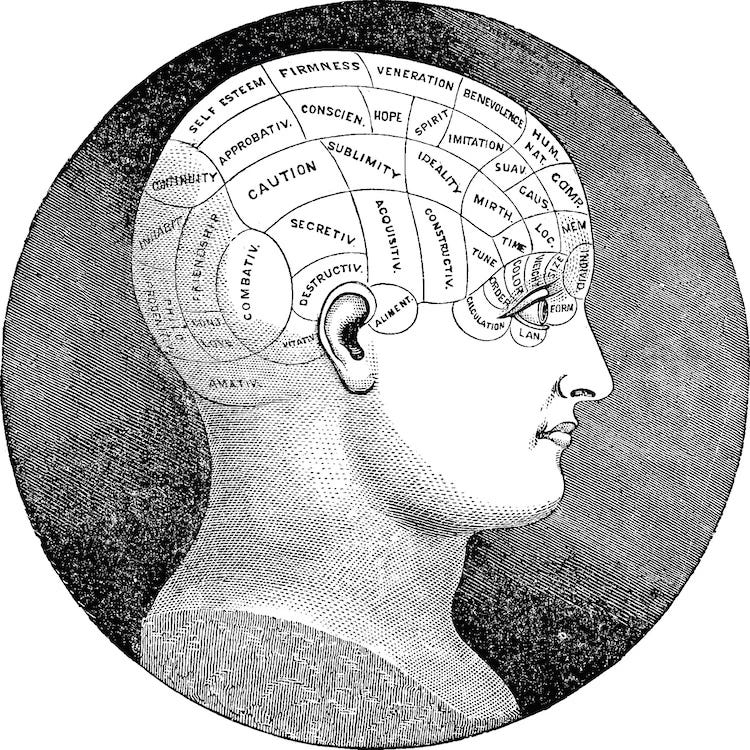
“You see,” he said, tapping a chalkboard where he had sketched a crude human profile, “the structure of the skull, the slope of the brow, the prominence of the jaw—these are not mere accidents. They are windows into character. The Italians have advanced this line of thinking admirably. Lombroso, for instance, demonstrated that criminals share certain common traits: asymmetrical faces, protruding jaws, small, shifty eyes, peculiar bumps and ridges.”
“Phrenology?” one captain scoffed. “Surely that’s out of fashion.”
“Out of favor with those who do not wish to face uncomfortable truths,” Haviland corrected. “Have you never looked at a man and known he was a bad seed before he spoke a word? The jaw tells. The temples. The occipital ridges at the back of the head. One day, we shall be able to identify potential criminals in childhood and intervene before they offend.”
Murmurs. Some skeptical, some intrigued.
“And what would you do with them, Major?” someone asked. “Lock them away forever?”
Haviland smiled—a little twist at the corner of his mouth I had not seen before. “Surely that is for the lawmakers to decide. We are merely the observers.”
He caught my eye then, purely by chance. I had paused with the teapot tilted, listening. For an instant, I saw something under the carefully cultivated veneer—impatience, perhaps, that I had overheard something not meant for me.
Then he smiled again, all warmth and gentility. “More tea, Nurse … Our little chemist, isn’t it?”
“Yes, sir,” I said. I poured him more tea.
“Later that night, I found him at the far end of Ward C, studying a sleeping soldier’s face by lantern light.”
“The heavy brow,” he murmured to himself.
When he saw me, he pulled his hand from his pocket and straightened.
“You needn’t concern yourself, Sister,” he said. “Just checking on the patients.”
“Of course, sir,” I replied.
“Except I did concern myself.”
This is a fictional story that uses history and iodine to narrate an elemental murder and mystery.
Look for Part 2 in April 2026
Who’s Sleeping in My Bed? 🛌
If you are from a genetic population outside of Sub-Saharan Africa, 1-4% of your DNA could have originated from a Neanderthal ancestor. And those Neanderthal genes from this interspecies coupling were retained by natural selection because they helped Homo sapiens adapt better to their environment.
They include: immune system genes to help us fight off viral infection, skin and hair genes that protect us from UV light, genes regulating how fast calories are burned, which may have been beneficial for survival but are now linked to weight gain and obesity (I think I have a bunch of these).
These Neanderthal genes are scattered across our chromosomes but are noticeably absent from the human X chromosome, one of two sex chromosomes—X and Y. Why? Studies suggest this was caused by biased mating patterns between Neanderthal males and human females.
To commemorate this finding …
Perplexity AI created this image using the author’s instructions.
I’ve always wanted to create my own meme.
SNEAK PEEK COVER: Shattered: A De-Extinct Zoo Mystery, Book 4
Some monsters are engineered. Some are rich. Some share your DNA.
Check back March 25th for the full reveal
At the Pleistocene BioPark, woolly rhinos, mammoths, and Ice Age predators are back from extinction—and someone is weaponizing them. When a fatal incident shatters the opening gala, Dr. Milly Smith has to protect her animals, her friends, and a pop star who might be her sister.
And For Women’s History Month: Echo of Lies
Women’s History Month fiction with ray guns, quantum ciphers, and a young woman’s resilience.
Francie Cortez, who loves Einstein more than etiquette, becomes the key to stopping a time‑bending conspiracy that has already killed one woman in her family and threatens millions more. To solve it, Francie has to treat everyone as a suspect, including the man who might be her best chance at the truth.
A PG sci-fi mystery historical romance about a woman’s resolve, you’ll want to read and pass on to your daughters and granddaughters.