Phosphorus, the Match Girl Strike, and the Periodic Table of Death and Mystery - 2
Periodic Table of DEATH and Mystery

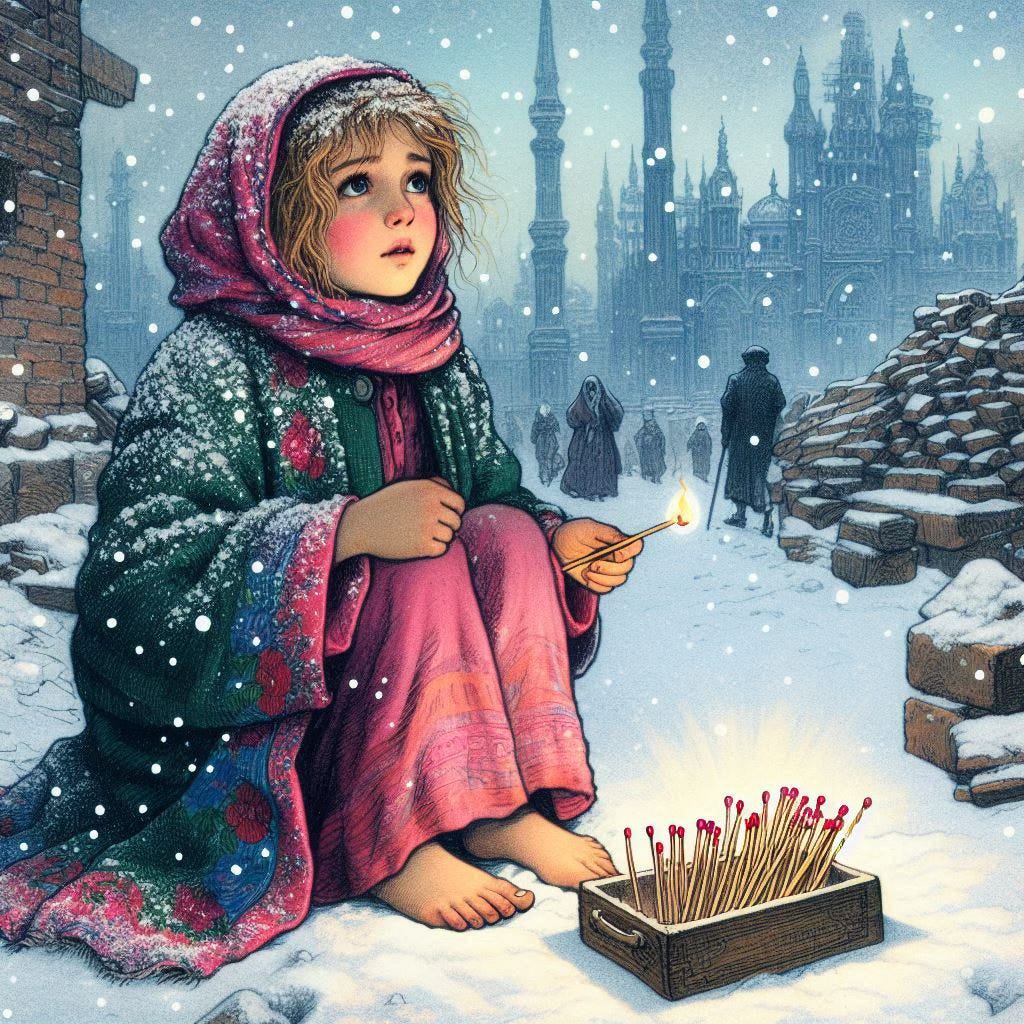
When we once lived in a world where everyone smoked, branded matchbooks were given out at bars and restaurants (Harry’s Hideout – Where’s it’s Always Happy Hour), and matchbooks in the coat pockets of murder victims are almost a cliché clue in mysteries. But there was a time when matches were a luxury item, when people—mostly children—sold individual matches on the street. Which made Hans Christian Anderson’s Fairy Tale The Little Match Girl (1845) … interesting. In Anderson’s tale, he implies that, at one time, matches had a higher innate value than children. Just FYI, read The Little Match Girl as an adult and dip into the analysis (1, 2). It’s a story that actually transcends time and is ultimately about compassion, hope, and, with a side of cutting irony, about how society values and treats the most vulnerable. To mix Fairy Tales and authors, “A person’s a person, no matter how small.” (3)
But what about the “persons” who made those matches in factories in the 1800s? Many of them fared just a poorly as the Little Match Girl and were just as vulnerable. To get to them, let’s review the history of matches—but only shallowly. If you are truly interested in the history of matches, there are lots and lots and LOTS of blog posts, videos, podcasts, and online articles because of how interwoven making friction-strike matches is with manufacturing, the upswing of workers’ rights during the industrial revolution, and a woman and girl-led manufacturing strike. We will specifically focus on the periodic table element phosphorus, its association with matches, and, unfortunately, death.
Phosphorus, which means “light bringer” in Greek, is the “morning star” god of the planet Venus (4). Phosphorus (P) as a periodic table element has an atomic weight of ~31, an atomic number of 15, and was discovered by the Alchemist, Hennig Brant (5), who was searching for the philosopher’s stone. But Brant kinda-sorta didn’t really understand what he discovered, other than it glowed in the dark and caught fire when exposed to air. It was Robert Boyle (1627-1691)—a naturalist, chemist, alchemist, physicist, cultured, sophisticated, man about town (6)—who put two-and-two together and was the first to use phosphorus to ignite “splints” tipped with sulfur, which were the forerunners of modern matches.
A number of attempts at creating usable matches for the public were unsuccessful and expensive until around 1830, when Frenchman Marc Charles Sauria (1812-1895) added phosphorus to the chemical mixture for friction matches (7). For the first time, matches made the control of fire, heat, and light on demand at the tip of their fingers for the ordinary public. This supercharged the Industrial Revolution, and it supercharged reading and writing. Demand for printed materials to read skyrocketed. Phosphorus matches made the common people more educated and literate, which I found in a couple of online articles, but without any primary references, although when I Googled “matches made people more literate,” there was a research article about how women on Tinder prefer more educated men (8). A more direct link of the availability of matches changing human culture would probably be the accessibility of phosphorus friction matches and the proliferation of cigarettes and smoking.
Mass manufacturing of friction matches ramped up after the 1830s when people displaced by the industrialization of agriculture flowed into cities like London to work in factories. Factory-manufactured matches were literally made by hand—thousands and thousands per day—the tips dipped into a chemical soup of sulfur and antimony, baked to dry, and finally coated in white phosphorus for the quick strike.
But conditions in the match factories were horrible. Fourteen-hour workdays, very poor pay, and no clean place to rest or eat. Most of the workers were young Irish women, including girls under 14 years old, and the factory foreman levied fines for the weirdest things, like dirty feet (many workers couldn’t afford shoes), untidy workbenches, talking, and deducting pay for matches that caught fire and burned, which could occur if they were accidently dropped to the floor. Then there was phossy jaw, directly related to the use of white phosphorus in making matches because white phosphorus is highly toxic (9).
Six periodic table elements make up ~95% of the human body and easily remembered by this mnemonic: CHONPS—Carbon-Hydrogen-Oxygen-Nitrogen-PHOSPHORUS-Sulfur. Fats, carbohydrates, and proteins—food—are composed of these elements, but the phosphorus makes up part of the energy molecule ATP: adenosine triphosphate. The body, therefore effortlessly absorbs the white phosphorus and, through natural chemical reactions with the body, turns it into amino bisphosphonates (10). You may have heard of bisphosphonates or have even been prescribed bisphosphonates for osteoporosis or post-menopausal bone loss. Bisphosphonates slow bone loss and can help strengthen bones, but bisphosphonates can have severe side effects.
Phossy jaw, which started with toothaches and led to painful and disfiguring jaw necrosis and infection (11), was known early on in the phosphorus matchstick industry, but there were no protections, and most workers who complained about jaw aches were fired.

Working conditions and severe health problems led to articles published about the workers’ conditions that ultimately led to the Match Girl Strike of 1888 in London. The factory owners insisted their workers sign a paper repudiating the articles, but the workers refused, and then the owners fired one of the workers in retaliation. By that afternoon, over 1400 women and girls had walked out of the matchstick factory on strike. A committee was formed to negotiate for the fines to be abolished and for better working conditions, which were accepted by the factory owners. A union was formed, which led to more and more unions and collectives for other types of factory workers, leading to better conditions. And in 1910, parliament passed an act prohibiting the use of white phosphorus in matches.
So, the Match Girl Strike of 1888 for better conditions—including getting rid of toxic phosphorus—changed the composition of friction-strike matches and truly made them universal—they were everywhere. Until they weren’t. Until they became a collector’s item because of the decrease in tobacco smoking and laws that banned smoking in public and private. But did you know matchbooks are making a comeback?
Can(nabis) you guess why?
Please enjoy AI’s imagined image of The Little Match Girl with 6 toes.