
Phosphorus, Match Girls, and the Periodic Table of Death and Mystery - I
Periodic table of DEATH and mystery

A friend of mine writes time-travel books, so let’s use Mr. Peabody’s (1) Wayback Machine (which, shockingly, doesn’t have its own Wikipedia page) to jump back to 1669 and an Alchemist named— No. Wait.
We first need to go back even further to 12th-century Medieval Arabic and European physicians and the fascinating subject of uroscopy—the divination of disease by the inspection of urine (2).
“While you look at the urine for a long time you pay attention to its colour, substance and quantity and to its contents from the diversity of which you will diagnose the different kinds of diseases . . . whereupon you promise health to the patient who is hanging on your lips.” (3)
The “scopy” part of uroscopy obviously implies simple visual inspection. But that was not always the case. In some instances, it was recommended that said physicians inspect by scent (some patients who didn’t trust doctors would send vinegar or wine to test the physician) or taste. Gives a whole new meaning to hanging on your lips.

Now that we are immersed in urine (sorry), we can hop forward to 1669 and the Alchemist, Hennig Brant (4), who was searching for the philosopher’s stone using—you guessed it, urine—and accidently discovered the element phosphorus (P) which he THOUGHT was the philosopher’s stone because it glowed in the dark and caught fire a lot when exposed to air. Remember, the philosopher’s stone was a substance everyone at the time believed could transmute base metals into gold. And since pee was golden colored …
Hennig’s recipe. Seriously. He left a recipe.
1. Take a good large Quantity of New-made Urine of Beer-drinkers … (5). A good quantity was apparently ~1500 liters, and Brandt was German. Prost!
2. Age the Urine till an Intense Odor billows out of the Samples, then evaporate it gently to the consistency of Honey. His laboratory was in the basement of his house. Pity the souls who lived above and his neighbors.
3. Boil the Urine until a White Paste materializes.
4. Place the Heated Paste in a Retort (a narrow-necked, round-bottomed glass flask)
5. Gold will drip out of the—
But gold didn’t drip out of the whatever. Instead, he accidentally discovered the first non-metallic chemical element. Yep. Hennig Brandt is the man who put the “pee” in Phosphorus (6).
The accidental part of the discovery is real. Brant couldn’t have known that phosphorus made up 0.12 grams per 100 mL of urine (7). That means he should’ve isolated ~1800 grams of phosphorus from his 1500 liters of collected urine. His method wasn’t efficient, though, and resulted in only ~120 grams (4). But he’d spontaneously made the glowing, combustible white phosphorus allotrope, which we will get to in a sec.
Phosphorus (P), which means “light bringer” in Greek, has an atomic weight of ~31 and atomic number of 15. Its abundance in the earth’s crust is about 1 gram per kilogram, but it’s never found in its free form and is mined from various inorganic minerals (8). Organically, it’s found in urine, bone, and other animal excreta (including human waste) and sourced from bird and bat guano during the 1800s, mostly as fertilizer (9) because phosphorus is absolutely necessary for life. Phosphorus is a component of DNA and RNA—the sugar-phosphate backbone—and plays a huge role in energy transmission as part of ATP—adenosine triphosphate. In our bodies, we store about 750 grams of phosphorus, mostly as teeth and bone in calcium-phosphate, and we eat about 1 gram of phosphorus-containing molecules a day.
But if you think that more is better, you would be wrong. When too much phosphorus from fertilizer or detergents gets into a watershed, it and other nutrients can cause algae blooms that deplete the water of oxygen and kill off fish and wildlife. The dead zone around the mouth of the Mississippi River in the Gulf of Mexico is a prime example (10). Plus, some allotropes of phosphorus are incredibly toxic. Only 0.1 grams of white (yellow) phosphorus can kill in some cases. In others, acute phosphorus poisoning manifests in an unusual symptom called “smoking stool syndrome,” which is a real thing. Not kidding, Jack. The authors of the 1976 JAMA article are F.A. Simon, MD, and L.K. Pickering, MD, and the title is “Acute Yellow Phosphorus Poisoning: Smoking Stool Syndrome” (11). What is sad is that the three cases detailed were for a 3-year-old, a 2-year-old, and a 7-year-old who had eaten phosphorus-containing rat poison. Only the 7-year-old lived. This announcement was in a local Colorado newspaper, the Montrose Enterprise, in 1911 (12) that detailed another tragic death from phosphorus ingestion: Matches.
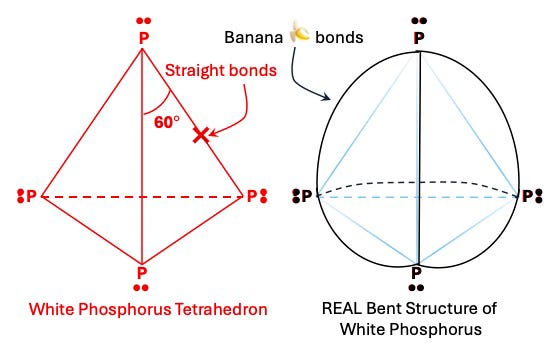
Elemental phosphorus had four different molecular forms or allotropes (13): white, red, violet, and black, the most common being white and red. White phosphorus in the volatile and toxic form and small amounts can spontaneously convert into red phosphorus, which is much safer. The conversion result is the “yellow” color of chunks of white phosphorus. So white and yellow phosphorus are essentially the same thing and still very toxic. The volatility of white phosphorus (glowing and catching on fire) can be explained by its chemical structure, P4. White phosphorus has a tetrahedral, pyramidal shape. But the covalent bonds connecting the P-atoms to each other aren’t straight. They are bent or bowed “banana” bonds (14, 15), which are very reactive. In the presence of oxygen and an increase in heat, white phosphorus bursts into flames.
Which brings us back to matches and the next exciting episode of the Periodic Table of DEATH and Mystery!