
Molybdenum, the Quiet Chemistry of Obesity, and the Periodic Table of Death and Mystery, Part 2
Shattered is coming out SOON. I've got images of Luther and Milly below ... AND Sacred Ghosts is a Killer Nashville Claymore Finalist!

Last time I left you with overweight/obesity data on a few world countries. For those who felt left out:
Mexico—around 70–75% of adults in Mexico are overweight or obes[CP1] e.
South America:
Brazil: adult obesity prevalence is about 25%, while overweight adults are ~50%.
Argentina: adult obesity is about 35–39%, but BMI-based data suggest roughly 70–75% of adults are overweight/obese.
Chile: adult obesity is around 34–42% and about 80–83% of adults are overweight/obese.
Central America: Regional Latin America/Caribbean estimates about 44–68% adult excess weight depending on country.
Africa (continent-wide overview): Adult obesity in Africa was about 12.8% but overweight percentages are rising rapidly. So for “Africa” as a whole, a conservative statement is: “roughly 25–30% of adults are overweight (including obesity) with regional differences.
Russia: Around 60% of adults in Russia are overweight, with roughly 20% obese.
Japan: ~ 25–30% of Japanese adults are overweight or obese, with < 5% in the obese range.
Southeast Asia: Some of the lowest overweight/obesity prevalence globally, but rates are rising quickly! About one in five adults in the South-East Asia Region are currently overweight.
I think the U.S. is #1!
And let’s look at the consequences of all that extra weight …
Our bodies don’t store protein. Our bodies store only enough carbohydrates (in the form of glycogen in muscles and the liver) for ~36 hours. What our bodies store extremely well is fat.
Why? Evolutionarily, fat storage was a hedge for survival. The ability to store excess calories as a dense energy reserve ensured survival, supported our massive, energy-hungry brains, and fueled successful pregnancies and lactation.

Except it’s only been a few millennia since humans had to deal with “feast or famine” during their lifetimes, which is NOT enough time for our genetics to adapt to the “feast” and sedentary world we live in today—for most nations, anyway.
The problem is, carrying extra fat on the body is not just a matter of storage. It changes how many systems in the body work, and xanthine oxidoreductase (XOR), molybdenum, and uric acid are part of that story (see part 1). In people with obesity/metabolic syndrome, studies find that higher activity of XOR in the blood tends to parallel higher uric acid, abnormal levels of blood fats (triacylglycerides), insulin resistance, and lead to a greater risk of high blood pressure and heart disease.
In other words, when XOR is more active, you often see a full clusterfark of metabolic problems. Drugs that block XOR can lower uric acid and often improve signs of oxidative stress and blood vessel function more than you would expect from the uric acid change alone. This suggests that the reactive oxygen species produced by XOR itself are an important part of the damage caused by being overweight.
Body Positivity
Modern “body positivity” has brought something valuable. It pushes back against shame and stigma, and it reminds us that people of all sizes deserve respect and good medical care.
What it can sometimes blur, however, is the difference between accepting people and pretending that excess visceral fat is harmless.
Large, long‑term studies are very clear that carrying a lot of extra fat around the abdomen is linked with higher rates of diabetes, high blood pressure, heart attacks, strokes, and certain cancers, even when blood tests look okay. Metabolically, “fat is fine” is only true up to a point. Beyond that, fat tissue itself becomes an active, stressed organ that increases inflammation and sends out chemical signals that change how the rest of the body handles sugar and fats.
When fat tissue “grows,” especially deep belly fat, its tiny blood vessels can’t keep up. Parts of the depot slip into low‑oxygen hypoxia, and cells there switch into stress mode, making extra reactive oxygen species and inflammatory signals.
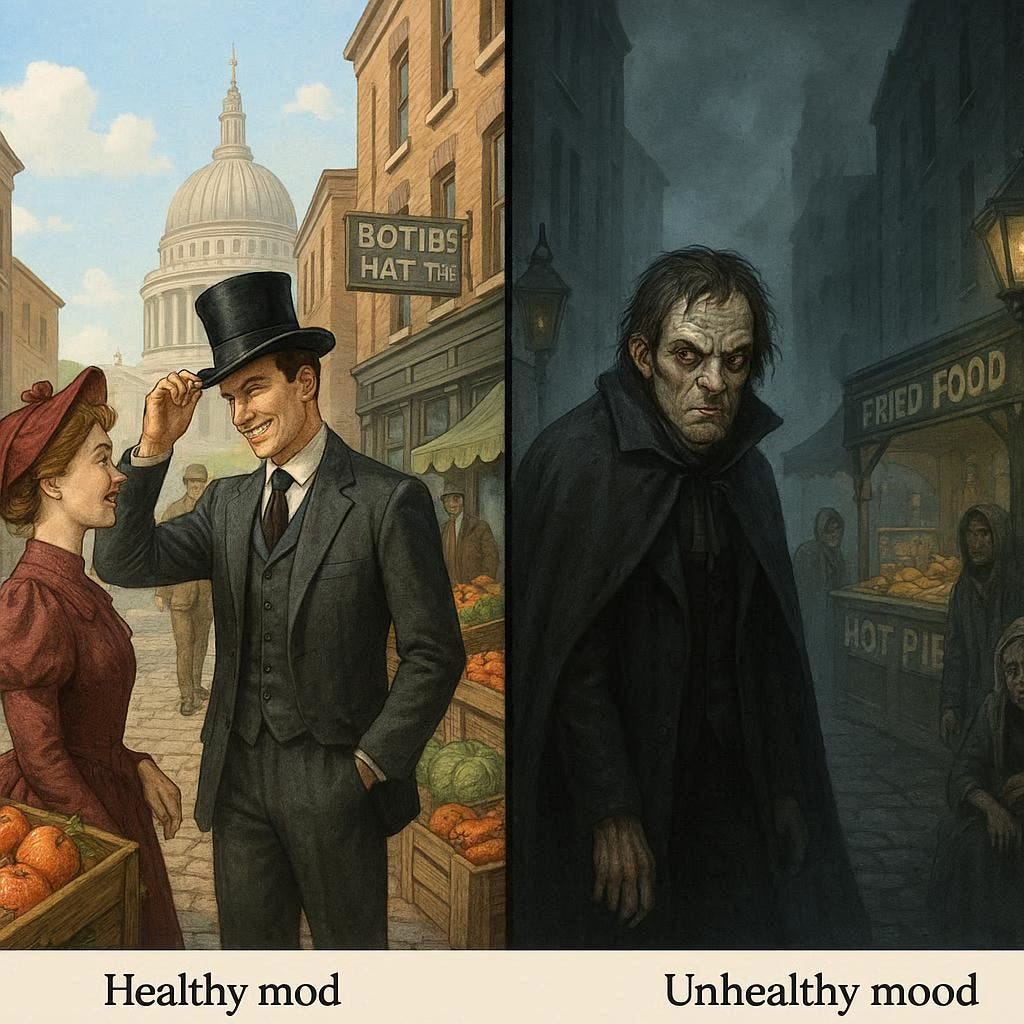
Over time, that stressed fat behaves like Dr. Jekyll and Mr. Hyde. In its Dr. Jekyll role, healthy fat stores extra calories safely, releases fuel between meals, and tells the brain and muscles how full the tank is (hungry or satisfied).
In its Mr. Hyde state—too big, poorly supplied with oxygen, and bathed in ROS and inflammatory chemicals—the depot leaks fatty acids into the blood, interferes with insulin, and keeps the rest of the body slightly inflamed. XOR and its molybdenum core sit inside that loop: higher XOR activity makes more uric acid and ROS → those further irritate fat tissue and blood vessels → irritated tissues send signals that keep metabolic stress switched on.
No single piece is the lone villain, but together they show why long‑term excess fat is not just cosmetic—it quietly reshapes body chemistry in ways that make chronic disease more likely.
If all of this sounds a little personal, it is. This is not a lecture aimed at “those people over there.” It is a biochemical mirror held up for anyone—this writer included—who is aging, carrying extra weight, battling high blood pressure and cholesterol, and wondering how much of this is inevitable.
The chemistry doesn’t care how we feel about it. But understanding how metals like molybdenum, enzymes like XOR, and tissues like fat fit together can make it easier to take our own risks seriously without shame.
Here are a few practical take‑home points to carry away:
Healthy weight is not just about appearance. Extra visceral fat changes chemistry in ways that raise blood pressure, blood sugar, and long‑term disease risk.
Uric acid is not only about gout. Chronically high levels can damage blood vessels, kidneys, and fat tissue, especially when XOR is very active.
Oxidative stress and low‑grade inflammation are useful in short bursts, but when they stay switched on, they quietly wear down arteries and organs over time.
What and how we eat matters. Excess calories, added sugars (especially fructose), and frequent purine‑heavy meals (large portions of red, game, or organ meat) give XOR more work to do.
Regular physical activity improves blood flow, nitric oxide availability, and insulin sensitivity, and can lighten the load on fat tissue and XOR.
Aging makes the system less forgiving—ugh. The older we get, the more important it becomes to nudge weight, blood pressure, and uric acid in the right direction instead of hoping they will behave on their own.
Wanting to change is often easier when it’s tied to someone we love. For many of us, that someone is a grandchild (or three). It’s one thing to read about uric acid, oxidative stress, and molybdenum in enzymes. It’s another to kneel on the floor to build a block tower, get back up without wincing, or take them to Disneyland for the day.
In that setting, strength and a little less weight aren’t abstract “health goals.” They’re what let you lift a sleepy child into a car seat, climb bleachers for a school band concert, or sit cross‑legged on the carpet for a board game.
Looking at the biochemistry is just one way of saying these choices matter—not only for blood vessels and joints, but for the ordinary, joyful moments with grandchildren that we want to be fully present for.
Shattered: A De-Extinct Zoo Mystery, Book 4 … SOON!
It’s BACK from my professional editor—and I was pleasantly surprised that everything she found was super easy to “fix”. The proofreader is next, then I will release it September 1, 2026!
BE SURE TO PRE-ORDER YOUR COPY ON AMAZON
If you prefer other retailers, I’ll have links for B&N, Kobo, and Draft2Digital at release time or before. There will also be a print edition.


I think I’ve shown you images of what I picture as Luther Nikolai and Milly Smith. I love the one of Luther. Milly at the gala, not as so much because her “living” dress is not quite like I pictured it in my head. It needs much more color and light—but it still works.
Here is an EXCITING excerpt of Shattered
Appleton raced outside, straight for Balder’s paddock, the flashing shock stick clutched in his hand. Shock sticks never soothed. They only linked pain with panic.
“No. Dr. Appleton!”
Milly sprinted after him, boots sliding on grit before she gained traction. But Appleton had too much of a head start. She wouldn’t catch him before he reached Balder.
He skidded to a stop at the paddock gate and pressed his hand against the biometry pad. The indicator light flicked green.
That shouldn’t be possible. His clearance had been revoked when he retired. Who had given him access?
The gate swung open, and Balder didn’t hesitate. He burst out of his pen on high, bristled alert, head swinging and tail raised.
Milly pinwheeled to a halt. Balder lifted his head, dark red woolly dreadlocks swinging.
Ten meters—too close. He could smell her, hear her gasping breaths, and see her standing there.
He charged.
Three tons of rhino bore down on Milly. She crouched. Running would only make her a target.
She had one chance …
This was a nice surprise.

Dear Carol Potenza-
I’m happily writing to let you know that Sacred Ghosts (Book 4 in the Nicky Matthews Mystery series) has been selected as a finalist for the 2026 Claymore Award for Best Literary.
That’s all for this newsletter. Thanks for getting down this far.



Congratulations on being a Silver Falchion finalist! Also this post is great motivation to keep up the exercise regimen!