
Manganese, Dark Oxygen Production, and the Periodic Table of DEATH and Mystery: Part 1
If your curiosity is stronger than your caution, dive in and discover just how dangerous the building blocks of the universe can be.

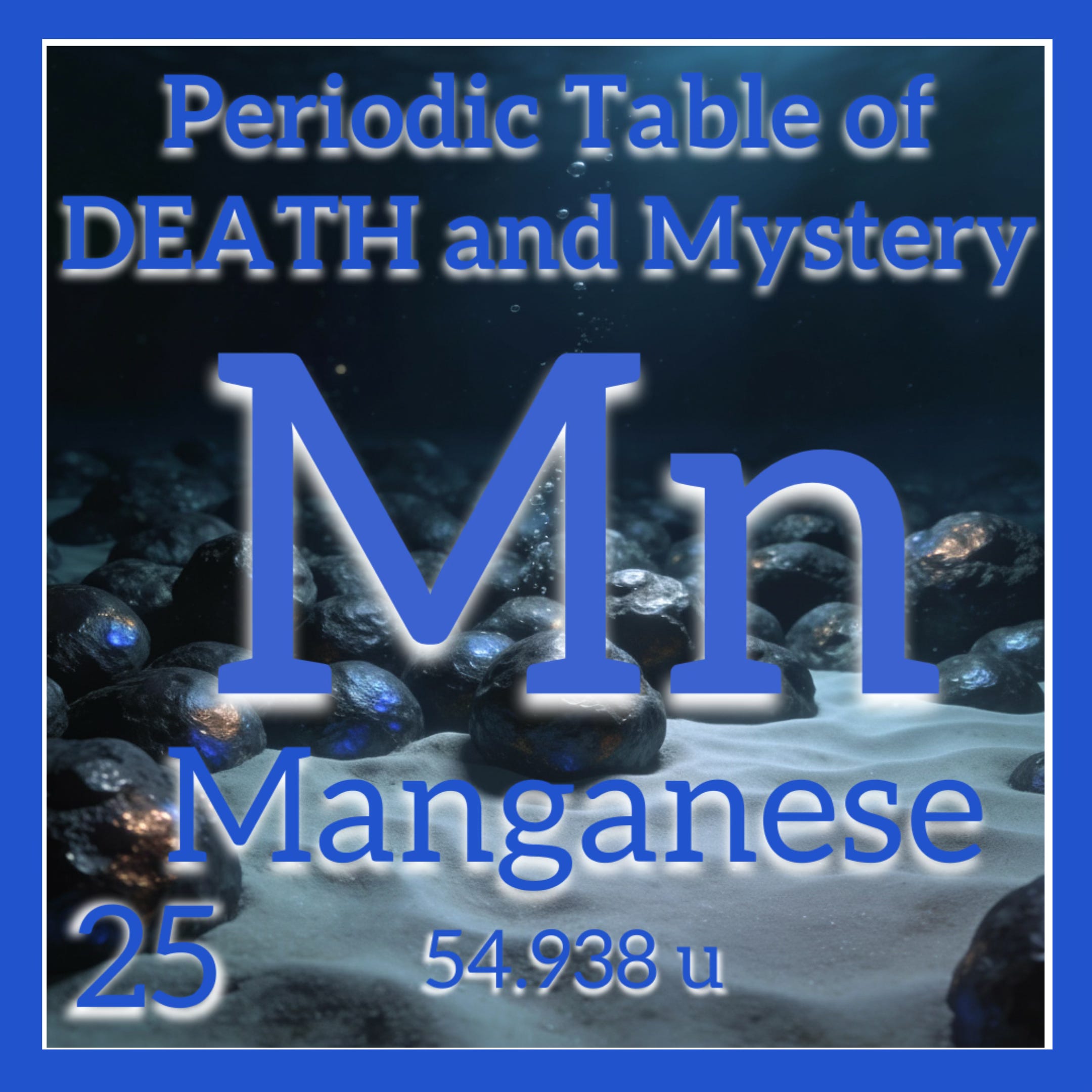
The discovery of dark oxygen production has been so exciting and, well, revolutionary. I mean, biochemistry has long taught that photosynthesis—and its dependence on light—is the major generator of the oxygen that fills Earth’s atmosphere and therefore is directly linked to life on this planet. The claim that another major method of oxygen generation had been found in the depths of our oceans challenges a scientific dogma that is almost sacrosanct, and it was published Nature.
Nature Journal? Is that important?
Why, yes. Publication in Nature (UK) or Science (US) is a big deal. These journals are among the most selective and widely read in all of science, so publication signals that the work is both rigorous and broadly important. Their articles are highly cited and closely watched by other scientists, funding agencies, and the media, which can boost a researcher’s visibility and career opportunities. It’s like:
The scientific equivalent of a Pulitzer Prize–level spotlight.
The research equivalent of a best-picture nomination at the Oscars.
Like your album going multi-platinum—among scientists.
After publication, the dark oxygen paper shot into the top tier of 2024 articles because the research is so “sexy.” There are online newspaper posts, YouTube videos, podcasts, excitement in the sci-fi writing community—
Total scientific clickbait.
But before we fall madly in love with this idea, let’s meet manganese
Manganese (Mn) is a silvery‑gray transition metal in group 7, period 4 of the periodic table with atomic number 25 and an atomic weight of about 54.94. One of its earliest uses was by prehistoric cave painters of the Lascaux region of France around 30,000 years ago. Isolated in 1774 by Swedish scientist Johan Gahn, it is moderately abundant in Earth’s crust (~0.1% by weight), occurring mainly in oxides (MnnOm) and hydroxides (Mnn(OH)m)—you also might remember pinkish manganese chloride (MnCl2) crystals in a chemistry set you got for Christmas or your birthday.

It’s especially concentrated in deep‑sea polymetallic nodules (we’ll come back to these in a sec). Manganese melts at ~1,245°C and boils at ~2,060 °C, so it’s great as a steel hardening alloy—the Romans used it in their weapons, and look how far they got. But a lot of its technical value is due to its multiple oxidation states, most commonly +2, +3, +4, and +7, which means a lot of electrons can flow through it. Electron flow means electrical generation and … batteries (like alkaline cells using MnO₂ as cathode material).
In biology, manganese is essential to life. It’s a cofactor for various enzymes and, critically, sits at the heart of the oxygen-evolving complex of photosystem II, where a manganese, calcium, and oxygen cluster (Mn₄CaO₅) helps split water into oxygen during photosynthesis or Light Oxygen Production (LOP). While trace manganese is a necessary micronutrient for human health, excessive exposure (especially airborne in “occupational” settings) can be neurotoxic, leading to manganism, a Parkinson‑like syndrome.
Back to deep‑sea polymetallic nodules, manganese, and Dark Oxygen Production
Deep-sea polymetallic nodules are potato-sized lumps of rock that sit loose on the abyssal seafloor, typically 4,000–6,000 meters (~2.5–3.7 miles) down. They grow over millions of years as metals precipitate from seawater around a core. They’re unusually rich in nickel, cobalt, copper, and manganese—all the elements needed for batteries (think energy generation for artificial intelligence), renewable energy tech (solar, wind), and electronics.
Because each field of these nodules (thousands and thousands of them) on the sea floor can contain very high concentrations of battery metals, countries, companies, and researchers see them as a key source for our energy transition from fossil fuels to “clean” energy. Harvesting these nodules could also decrease terrestrial mining in sensitive areas.

But these fields aren’t sterile. Nodules act as habitats for deep‑sea animals and microbes (another thing we’ll get back to), creating unique environmental communities that don’t exist on the surrounding soft mud—so nodule fields themselves could be considered “sensitive areas.”
Studies on the impact of nodule mining are ongoing, and many are funded—surprise—by mining companies. One high-profile example is Sweetman, A.K., Smith, A.J., de Jonge, D.S.W. et al. Evidence of dark oxygen production at the abyssal seafloor. Nat. Geosci. 17, 737–739 (2024).
Sweetman et al. used a common method to measure oxygen in their study: Benthic chambers. Briefly, imagine putting an upside-down mixing bowl on the seafloor, trapping a patch of water and sand—or polymetallic nodules—so you can watch how they “breathe” over time. The chamber is a sealed, usually clear dome or cylinder pushed into the seabed that encloses sediment, organisms, and the water above, so scientists can track how gases like oxygen change inside without disruption from waves or currents. Sensors inside constantly record oxygen levels, letting researchers see whether life in the sediment is using up oxygen (as expected) or whether something in that little patch is mysteriously making more.

To support such a bold claim as dark oxygen production, rigorous repetition and well-designed controls are essential. Doing that kind of work on the abyssal seafloor, miles beneath a research vessel, is anything but trivial or easy.
What Sweetman’s “dark oxygen” study claims
Sweetman’s team placed benthic chambers on nodule-rich abyssal seafloor in the Clarion‑Clipperton Zone, an area rich in polymetallic nodules. They expected to see oxygen slowly decrease inside the chambers as microbes respired. Instead, in several chambers, dissolved oxygen rose over two days, even though there was no sunlight and no photosynthesis at those depths.
Unexpected? Oh, yeah.
Since the seafloor in the CCZ is carpeted with polymetallic nodules containing the same manganese and other metals used in both electrical current generation AND photophysiologic light generation, the team proposed that these nodules act like tiny “geobatteries”, generating electrical currents that split seawater into hydrogen and oxygen inside the chambers(!)
Sweetman et al. even tested the generation of electricity in polymetallic nodules in the lab and found one nodule that generated 0.95V. Not enough to split water to oxygen and hydrogen (~1.5V is needed for that), so they hypothesized that electrochemical reactions on and between nodules might be driving oxygen production.
And, because this oxygen would be produced in total darkness and potentially support seafloor life or even have implications for how early aerobic life could have started on Earth, they called it “dark oxygen,” suggesting it might be a previously unrecognized oxygen source in the deep ocean.
This finding is ground-breaking and is making scientists rethink everything from the start of life on Earth to the potential of life on dark moons and planets …
Until you read the rebuttals to the article. They are strong because they argue that Sweetman et al. did something researchers are not supposed to do: they discarded data that didn’t support their hypothesis.
Which we’ll hear about in the next episode of the Periodic Table of DEATH and Mystery. Oh. And those microbes on the deep-sea floor? Could they be the source of oxygen instead of the nodules? We’ll learn something about that, too.