
Manganese, Dark Oxygen, and the Periodic Table of DEATH and Mystery, Part 2
If your curiosity is stronger than your caution, dive in and discover just how dangerous the building blocks of the universe can be ...

The potential discovery of “dark oxygen” is tangled up with manganese (Mn), the workhorse element in nature’s water-splitting machinery. In plants, a manganese cluster in photosystem II powers classic “light” oxygen—the oxygen-generating mechanism we’ve long treated as “settled science.” Briefly, sunlight boosts chlorophyll electrons into higher energy states. Those electrons then move through a chain of carriers so plants can combine carbon dioxide and water into carbohydrates and, as a bonus, release oxygen.
(6)Carbon dioxide + (6)water + light —> (1)glucose or carbohydrate + (6)oxygen molecules
6CO2 + 6H2O + photons —> C6H12O6 + 6O2
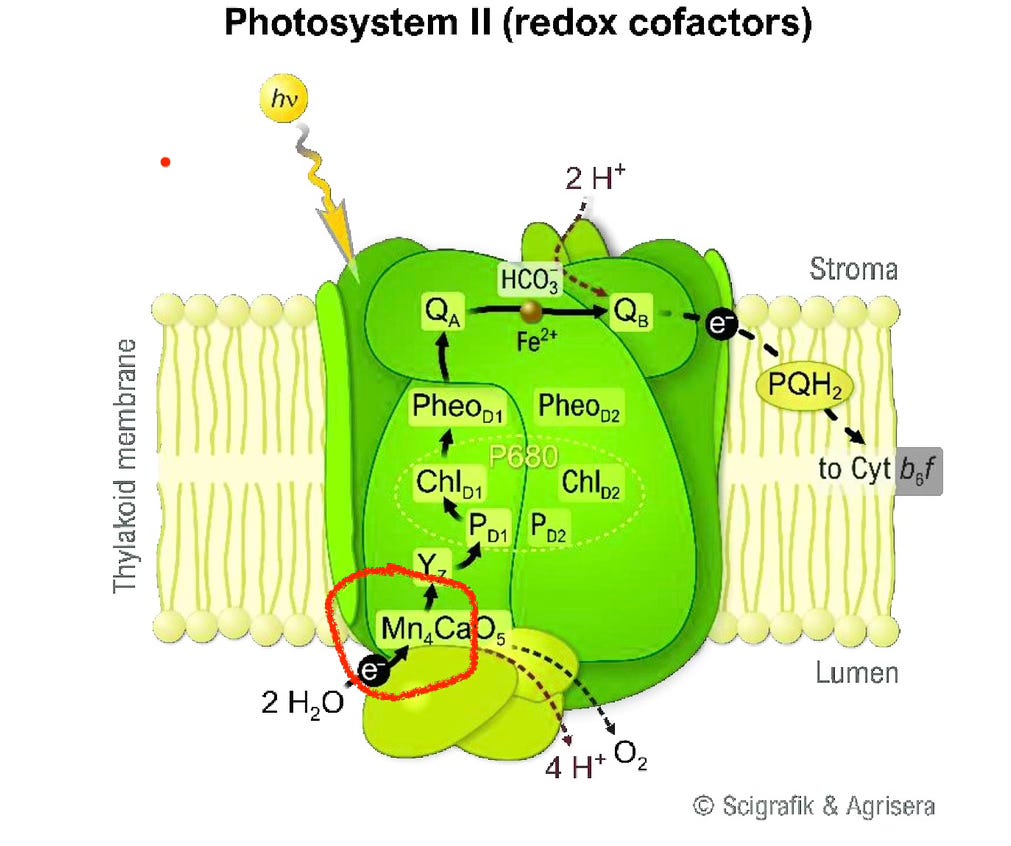
In the overall photosynthesis reaction, 24 electrons must move for each molecule of glucose made, and they must be replaced for the process to continue. Manganese in the water‑splitting complex raids water molecules for those replacement electrons, leaving behind hydrogen ions (H⁺) and O₂. Voila! The oxygen that helped ignite life as we know it.
But can we move electrons without all the messy trappings of life? Yes—in batteries. Electron flow is how we generate electricity, and electron‑conducting metals from the periodic table—including manganese—make that possible. These metals are in short supply, so we’re hunting for untapped sources, like the polymetallic nodules scattered across the abyssal (what a great word) trenches of the oceans.
Manganese (Mn) is a silvery‑gray transition metal in group 7 with atomic number 25, best known today as a steel‑hardening workhorse (think Damascus‑style steels and swords) and a pillar of alkaline batteries. What makes manganese especially interesting is its willingness to vary oxidation states—most commonly +2, +3, +4, and +7—shuttling electrons in ways that anchor both industrial chemistry and biological energy flow.

Humans and manganese go back millennia. Some of the paint used in the 17,000‑year‑old Lascaux cave drawings of Ice Age animals was made from scarce manganese oxide minerals, including hausmannite. The closest known manganese‑rich source for Lascaux is in the central Pyrénées, about 150 miles (~250 km) away. Manganese oxides ground and mixed with animal fat produced a permanent black worth enough to those artists that they expended serious effort to get it.


Which is exactly what’s happening now with abyssal polymetallic nodules and the recent controversy over the Sweetman et al. Nat. Geosci. 17, 737–739 (2024) article. A mining group, The Metals Company (TMC), commissioned the Sweetman expedition to the Clarion–Clipperton Zone, where these nodules sit between about 9,800 and 19,700 feet (4,000–6,000 m) down. This is not trivial fieldwork.
Sweetman et al. reported that the nodules, acting like natural batteries, produce oxygen in the darkest regions of the ocean—“dark oxygen.” If true, this finding could completely upend our understanding of Earth’s oxygenation and the evolution of life. It could also mean that mining these nodules risks disrupting a key deep‑sea system that helps keep the oceans oxygenated and, by extension, could destabilize life‑supporting conditions for the entire planet(!)
For the authors, the benefits are immense: a high-visibility Nature paper, substantial new funding ($2.7 million over three years from the Nippon Foundation) to lead a dedicated “dark oxygen” project, leadership of multiple deep-sea expeditions, strong media attention, and a central role in a politically hot scientific question.
Except … there’s a problem.
TMC, which also has an enormous financial stake in nodule mining and the future of “clean” energy—the definition of a conflict of interest—had access to all the raw data and research notes from these experiments. They accuse Sweetman et al. of omitting data that didn’t support their results and repurposing data from another publication without citation. One major point: some of the experimental chambers that supposedly produced dark oxygen contained no nodules at all.
Is this fatal to the dark‑oxygen hypothesis? No. Let’s consider two paradigm‑shifting examples.
Gregor Mendel, a 19th‑century monk and the father of modern genetics. Two things. First, his pea‑crossing data might have been “cleaned up” because the results were almost too perfect. But scientific consensus has shifted away from calling him a conscious fraud toward seeing this as data grooming in service of a basically correct insight. Second, although Mendel mentions work on other species (e.g., Phaseolus beans, Mirabilis jalapa, Hawkweed/Hieracium), he doesn’t present detailed tables for them the way he does for peas—most likely because their trait sorting didn’t support his pea data. Later geneticists rediscovered Mendelian ratios independently, and Mendel’s model lined up beautifully with future genetics. No harm done.
Martin Fleischmann and Stanley Pons’s cold fusion (1989). They claimed room‑temperature fusion from electrochemical cells, citing excess heat, neutrons, and tritium. If cold fusion were real, it could have revolutionized energy production. But no one could reliably replicate their results, and multiple papers were retracted. Cold fusion became another casualty of pathological science, where “people are tricked into false results... by subjective effects, wishful thinking, or threshold interactions.”
Replication is the key to good science, and Sweetman has been commissioned to do just that—but he has huge stakes and an obvious conflict of interest. So replication must also be external: another, non‑affiliated group has to reproduce the dark‑oxygen signal.
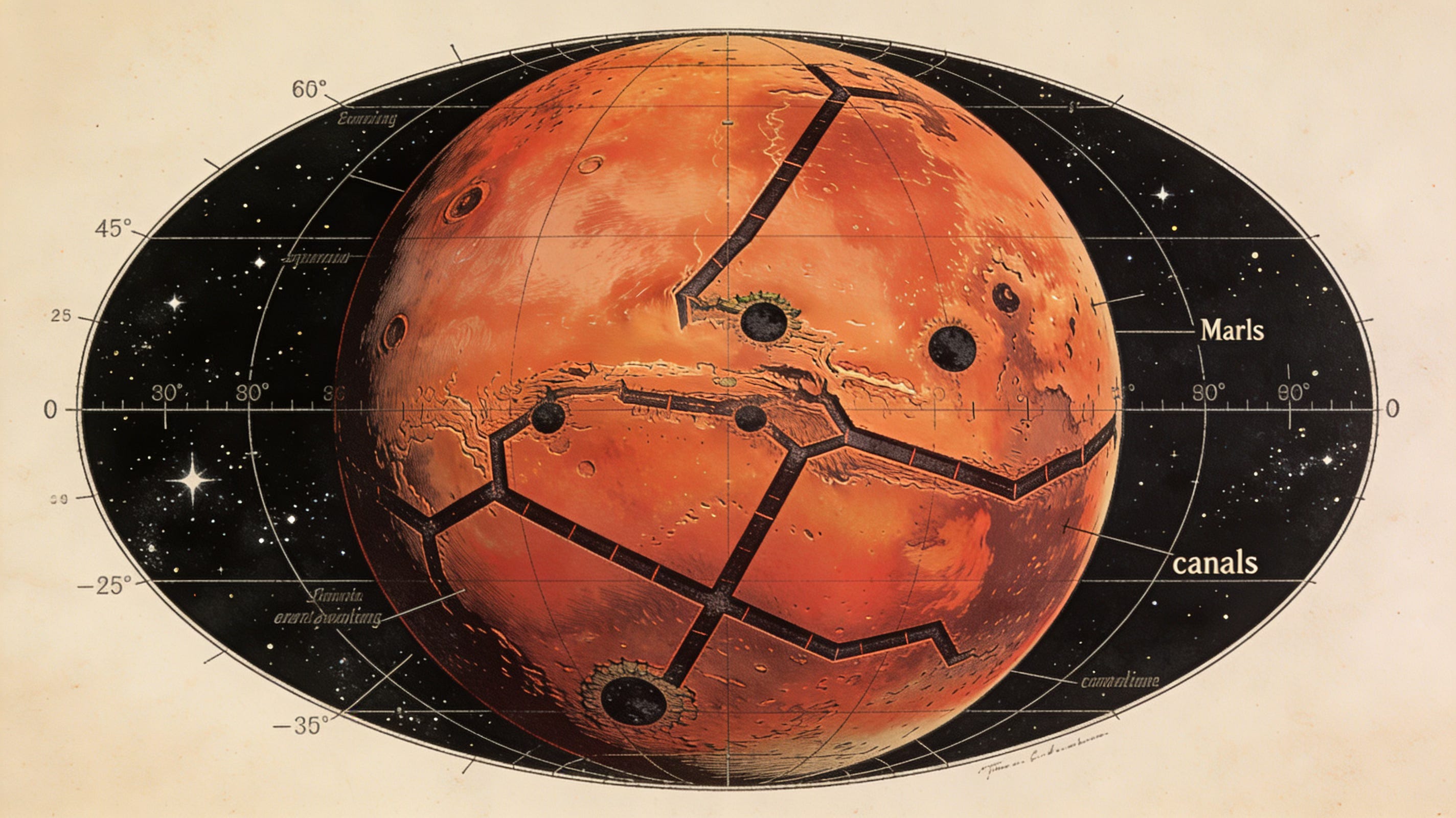
If they do, every science textbook will need an update. If not, dark oxygen will go the way of Percival Lowell’s Martian canals.
All references are linked in the article
I read about Mn in The Story of Science and found its human history fascinating. This reminded me why, again! Thanks so much!