Cobalt, a tale that pivots on a HUGE coincidence, and the Periodic Table of DEATH and Mystery
Seriously, you won't believe this TRUE story of the element cobalt. Oh, and BTW, Shattered is BACK from the proofreader, and I am loading it up for RELEASE on September 1st!

Shattered: Releasing September 1st!

Excerpt:
“No. Dr. Appleton!”
Milly sprinted after him, boots sliding on grit before she gained traction. But Appleton had too much of a head start. She wouldn’t catch him before he reached Balder.
He skidded to a stop at the paddock gate and pressed his hand against the biometry pad. The indicator light flicked green.
That shouldn’t be possible. His clearance had been revoked when he retired. Who had given him access?
The gate swung open, and Balder didn’t hesitate. He burst out of his pen on high, bristled alert, tail raised.
Milly pinwheeled to a halt. The rhino lifted his head, dark-red woolly dreadlocks swinging.
Ten meters—too close. He could smell her, hear her gasping breaths, see her standing there.
He charged.
Word of Mouth: Coincidence
Cobalt’s PToDM has a coincidence so amazing, it dropped my jaw.
But coincidence in fiction—mystery, thriller, and suspense—can sometimes make you want to throw the book at the wall.
Like this. We were watching a Netflix short series (6 total episodes) about a missing teenager. He’d run away before, and he was having “trouble” with his mother because she was overprotective, and she’d slipped a spy app on his phone that could read all his texts. So it was plausible he’d run away to teach her a lesson.

Tracking technology was available (widely in 2008—Netflix series was released in 2022), yet even though it seems logical, she didn’t have a tracking app on his phone.
Around episode 4, the mother was shamed into deleting the spy app, but the plot kept ratcheting up such that it became obvious something BAD had happened to her son (Episode 5). What should they do?
That’s when her husband says, ‘Hey. I just happen to know the CEO of a cellular phone company who can trace the location of our son’s phone.’
What a wonderful coincidence that he happens to know a guy!

My only conclusion is that the teen’s mother didn’t use a tracking app because if she did, then the rest of the plot couldn’t happen, so ... coincidence.
Here’s the rule I use for coincidence in fiction:
Coincidences that get characters into trouble are fine—even good. Coincidences that get them out of trouble feel like cheating.
Cobalt, a tale that pivots on a HUGE coincidence, and the Periodic Table of DEATH and Mystery
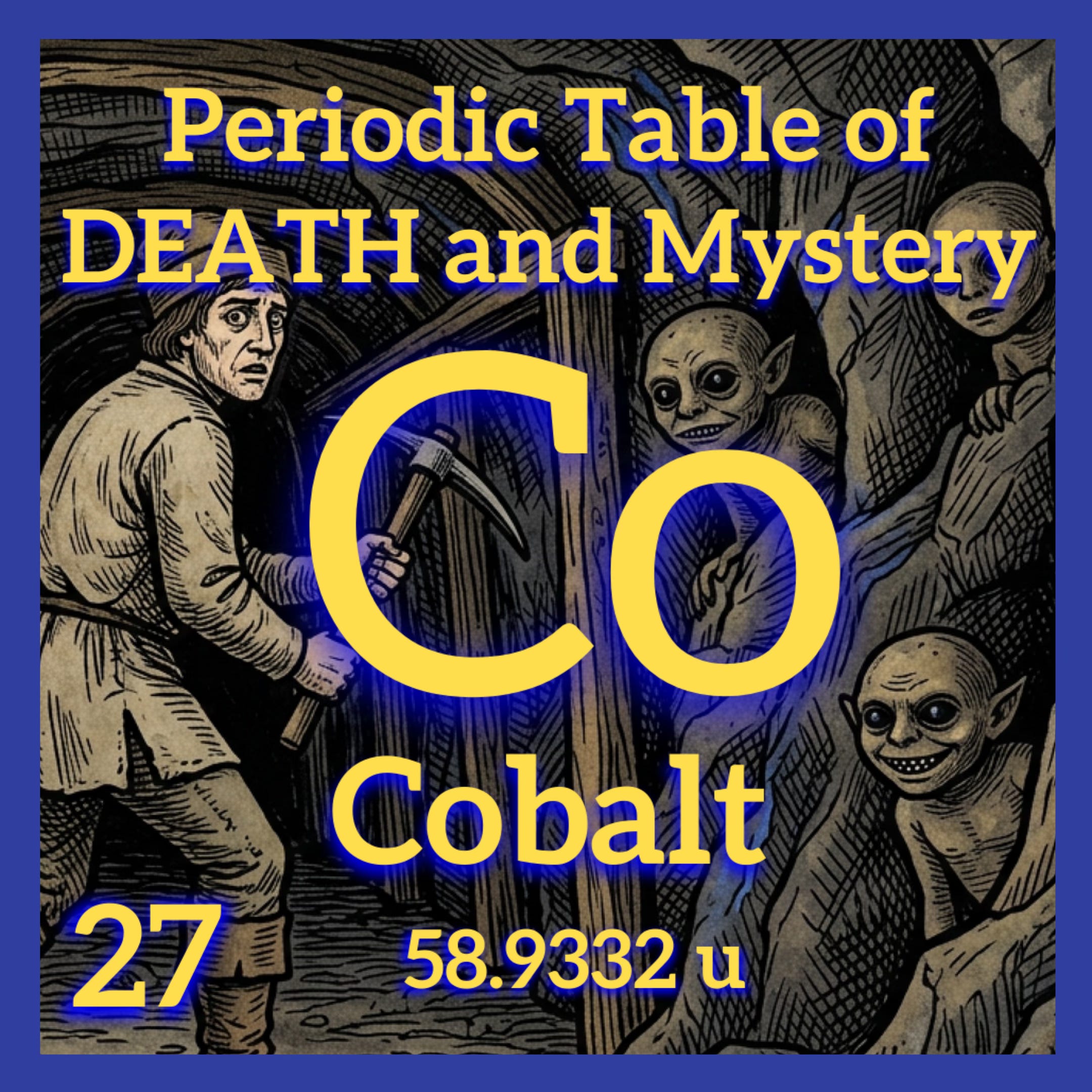
Today’s periodic table element is named after the German word for “goblin” or “evil spirit—kobold. Medieval and early modern miners in the Harz Mountains blamed these mine spirits for “spoiling” their silver ore when it produced no silver, gave off arsenic fumes when smelted, thus occasionally poisoning them. In 1735, chemist Georg Brandt finally isolated the actual metal hiding in kobold rock and, with a sense of humor I truly appreciate, kept the goblin name: cobalt (Co).
Cobalt—with an atomic number 27 and atomic weight 58.93—sits with iron and nickel in group 9, period 4. It’s a hard, silvery‑gray, ferromagnetic transition metal with a high melting point of about 1495 °C, which makes it useful in high‑temperature jet engine alloys. In its most common oxidation states, +2 and +3, cobalt forms a wide range of intensely colored complexes, shows up in blue pottery glazes and pigments, and sits at the core of vitamin B₁₂—making it an essential trace element for humans.

Cobalt has multiple radioactive isotopes, but the one of greatest practical importance is cobalt‑60, which is produced by nuclear reactors and has a half‑life of about 5.27 years. It decays by emitting two high‑energy gamma particles, which makes it both an excellent source of gamma radiation therapy for cancer. Starting in the 1950s, cobalt‑60 became the go-to source of what’s called external beam radiotherapy. Machines were developed to house encapsulated cobalt‑60 sources that produced focused beams of gamma rays into tumors to shrink or destroy them, like gamma knife technology, and that kill residual cancer cells after surgery. In fact, cobalt‑60 units remain in use worldwide because they are “robust and comparatively affordable.”
Here’s where things get a little more interesting and where our cobalt story starts.
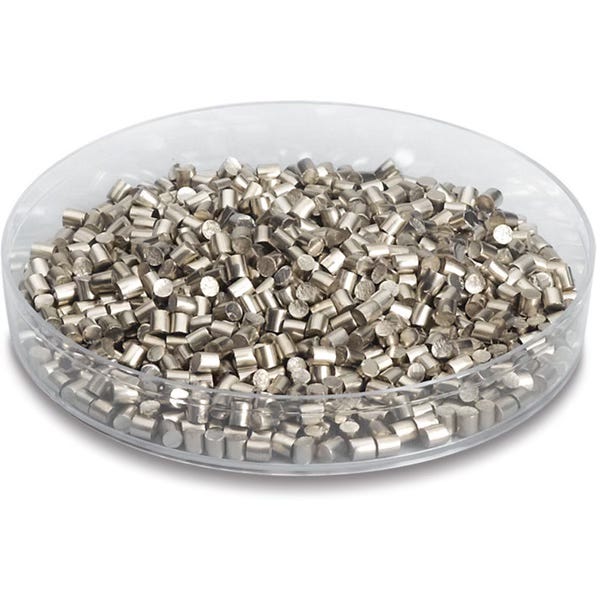
Let’s talk about one very specific cancer-therapy machine: a Picker C 3000 unit used in Lubbock, Texas. Manufactured in the late 1950s, it contained 6010 tiny metallic cobalt-60 pellets. Those pellets were sealed inside a stainless-steel capsule embedded in a tricycle-sized wheel made of tungsten, then slotted behind thick lead shielding. Radiation was released through a pinhole in the lead—just a pinhole—focused to kill cancers. The machine was specifically designed to keep its radiation safely contained and controlled.


In 1977, the hospital sold the unit to an X-ray equipment company in Fort Worth, that then sold it to the Centro Médico de Especialidades, a private hospital in Juarez, Mexico. According to the U.S. Nuclear Regulatory Commission, the sale was not reported, nor did the Mexican clinic have a license to receive radioactive materials. Great.
Once the machine reached Juarez, it sat in a warehouse because the clinic’s doctors said they couldn’t find and hire a specialist needed to operate it.
Then, in November 1983, an electrician who worked at the clinic, Vicente Sotelo, was told to scrap the machine, and sell it to the Jonke Fenix junkyard in Juarez. He and a co-worker took the machine apart because it was too big to fit in the back of his pick up truck, then loaded up the tungsten wheel containing the radioactive pellets. Curious, Mr. Sotelo drilled open the cobalt-60 containing capsule in the back of his truck to see whether there was anything valuable inside. Roughly 15 percent of the pellets—about 900—fell out and lodged in the cracks, seams, and nooks of his truck bed.
Mr. Sotelo had no idea. He parked the truck a few streets from his home after it broke down. It sat for eight weeks beside a row of back-street houses. Children played on and near it. Neighbors walked past it every day.
The truck was dangerously “hot.” From only a yard away, it emitted 0.5 grays of radiation per hour.
Just FYI, each pellet emitted about 0.25 gray per hour at a distance of two inches. For perspective, 0.01 to 0.5 gray per hour is a significant radiation dose. At that rate, about three hours of close, unshielded exposure could equal 0.8 gray—the lower end of the whole-body doses received by Chernobyl emergency workers diagnosed with acute radiation sickness. Roughly twenty-six hours at that same distance would reach 6.5 gray, a dose range associated with many of Chernobyl’s early fatalities.
For comparison, the maximum estimated exposure at the Three Mile Island accident was less than 100 millirem, making the cobalt pellet’s dose rate ridiculously high.

By early December, Mr. Sotelo had sold the cobalt-60 capsule into the salvage yard (for ~$9). Investigators could date the disposal precisely because every piece of paperwork from the junkyard dated December 6 or later tested radioactive.
So ~85 percent of the cobalt pellets contaminated the junkyard. The broken capsule was dumped near a huge magnet used to lift scrap metal into trucks for shipment to Mexican foundries. The capsule itself was made of nonmagnetic metal, but whenever it got covered and wrapped in metal, the magnet picked it up, then dropped it again and again—scattering more pellets across the yard.
But cobalt-60 is magnetic. The pellets stuck to the magnet and were mixed into the outgoing scrap metal. Some were pulverized and spread through the yard. Others may have embedded in truck tires and traveled down highways. Because of course.
Then it got worse.
Over time, about 80 percent of the radioactive cobalt pellets made their way to two foundries. One, in Juarez, manufactured metal table legs and shipped them to the largest distributor of restaurant tables in the United States. The other, in Chihuahua, produced tons of rebar—the steel rods used to reinforce concrete in buildings.
Between December 1983 and January 1984, about 600 tons of cobalt-60-contaminated steel crossed into the United States.
And the jaw-dropping coincidence?
Radioactivity is undetectable unless there is some kind of detection device, and those 600 tons of contaminated steel would never have been found except—
In January of 1984, one of the trucks carrying rebar activated a radiation alarm because a truck driver took a wrong turn and accidentally trundled through the entrance and exit gate at the Los Alamos National Laboratory in New Mexico! Yep, the Manhattan Project Lab, the Oppenheimer lab, the lab that developed the first atomic weapons (and makes an appearance in one of my books, Echo of Lies). What are the odds?

From that alert, authorities in Mexico found Mr. Sotelo’s radioactive truck and traced the cobalt-60 back to the clinic and junkyard—which was immediately closed. All of the radioactive table bases were found (over 60,000!) but only 90% of the rebar. Luckily with a half-life of 5.27 years 99.9886 percent of its original radioactivity will have decayed by now (2026).
A wrong turn found the contamination.
And that, folks, is how you do coincidence.
We are all inundated with “content,” and it can become overwhelming. Thank you for choosing to open my newsletter, read it, and for choosing my books!