
Beryllium, the Demon Core, and the Periodic Table of DEATH and Mystery, Part 2
If your curiosity is stronger than your caution, dive in and discover just how dangerous the building blocks of the universe can be ...

In part one of the beryllium (Be) story, you learned that four atomic cores were created for the Manhattan Project, but only three were detonated.
The fourth atomic bomb, made up of plutonium and gallium (Pu/Ga) and originally nicknamed Rufus, was moved back to Los Alamos, New Mexico, for further research. In short order, it acquired a new name—the Demon Core—when two scientists who used it to examine criticality would end up dead. The scientist linked to beryllium, Louis Slotin, exhibited a reckless carelessness that could have wiped out Los Alamos and its surrounds from an atomic explosion. Carelessness he rectified by sacrificing himself.
But first, a little about beryllium. With the atomic number 4, it’s the fourth element of the periodic table, group 2, period 2. In pure form, it’s a lightweight, brittle silvery metal with a high melting point (2468°C, 4474°F). Beryllium tastes sweet if licked, which is kind of a weird property, and its discoverer, Nicholas Louis Vauquelin (1763-1829), originally wanted to name it glaucinium (glykys is Greek for sweet). Instead, it was named for the gemstone, beryl, which contains beryllium.
Now that you know beryllium tastes sweet, you might be curious to lick it yourself. Don’t. Beryllium is toxic to humans in pure form if ingested or inhaled.
In criticality research on the atomic bomb cores, beryllium was used to create tampers—half dome-shaped bowls similar to those metal cloches that cover room-service food at fancy hotels. The tamper’s beryllium composition was very important because the element beryllium reflected neutrons back into the Pu/Ga core. They were used experimentally to assess the core’s neutron multiplication rate.
The caveat? If the core ever became completely surrounded by the beryllium tampers, too many neutrons would be reflected back to it, start a super-critical chain-reaction, and—nuclear detonation, which would be Bad.

A gap was left between the two encasing tampers so some of the neutrons could escape. During criticality experiments, the bottom half of the spherical Pu/Ga core was nestled inside the first tamper. The second tamper was used to cover the top half of the core and was manually controlled by the scientist conducting experiments.
You heard that right. Manually controlled.
The scientist raised and lowered the top beryllium tamper using a thumb hole. To maintain a gap for neutron escape, protocols dictated that shims be placed between the two beryllium tampers such that the core was NEVER completely covered.
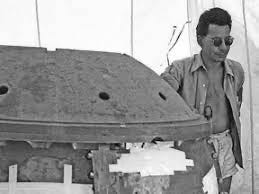
Louis Slotin ignored protocol. Instead of shims, he used a flat-head screwdriver to control the size of the gap between the two tampers. He was known to be a bit of a show-off and photos of him at Los Alamos saw him dressed in blue jeans, cowboy boots, and aviator shades. The Cool Physicist.
He was adept at “tickling the Dragon’s Tail,” which these criticality experiments had been labeled because they were extremely dangerous.
Slotin and seven other lab personnel, from technicians to scientists, to a military guard, were present on May 21, 1946. Slotin was demonstrating his method of measuring criticality using the beryllium tamper and his screwdriver. This time, the screwdriver slipped. The beryllium tamper slammed down, completely covering the core.
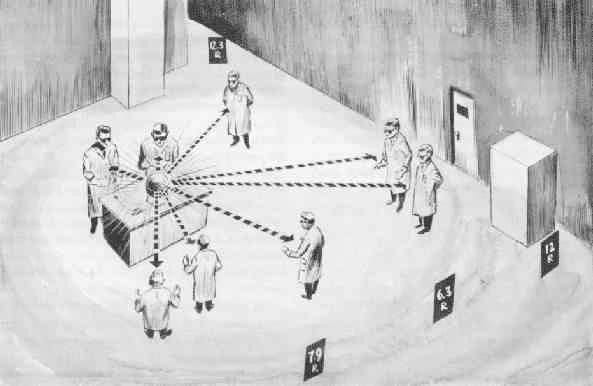
Instantly, the room filled with a blinding flash of blue light and a wave of burning heat. The core turned supercritical, releasing a burst of radiation. A nuclear explosion was imminent.
With a twist of his wrist, Slotin flipped the beryllium tamper to the floor and stopped the chain-reaction build-up and blast.
But it was too late for Slotin. His position over the supercritical core shielded the other men in the room but caused him to receive a lethal dose of radiation. He died of acute radiation poisoning nine days later.
You know what the saddest part was? Louis Slotin was leaving Los Alamos for a teaching position at the University of Chicago. His last interaction with the Demon Core was atraining demonstration for his replacement. Knowing he would die, Louis called his parents, who were flown to his side to be with him in his final hours.
After Louis Slotin’s death, Los Alamos ended hands-on work with the nuclear bomb cores.