
Beryllium, Criticality, and the Periodic Table of DEATH and Mystery, Part I
If your curiosity is stronger than your caution, dive in and discover just how dangerous the building blocks of the universe can be.

I despaired of finding anything to write about beryllium (Be), and then I saw Oppenheimer (2023). It is a seriously fine movie, and I highly recommend it. It also exposed an embarrassing hole in my education of what was probably one of the most profound discoveries in the history of man*—unlocking the nuclear power of the elements that reside in the periodic table.
Not only that, but I live in New Mexico and have never visited the Trinity Site (only 150 m/250 km from my house) or truly understood what Los Alamos meant, even though I once worked in a lab with a scientist who was part of the Manhattan Project and who signed the Szilárd petition.
A little atomic bomb history before we get to beryllium. In the early 1940s, two different elements were used to create the cylindrical or spherical pit cores of four fissile nuclear weapons during the Manhattan Project, three of which were detonated during World War Two: The Trinity Site bomb core (nicknamed Gadget) was of plutonium (Pu) mixed with gallium (Ga) for stability, as was the Fat Man bomb dropped over Nagasaki, Japan. The core of Little Boy, which was dropped on Hiroshima, Japan, was made up of uranium (U).
Because of enrichment issues, more uranium was needed for the detonation (64 kg/141 lbs.) than plutonium (core weight 6.2 kg/13.66 lbs.). The amount necessary for a sustainable fissile detonation was linked to something called criticality. It’s sort of a measurement of how close or far away fissile material is to detonation and depends on factors like amount of material, density, shape, and neutron reflectors (this is where beryllium will come in).
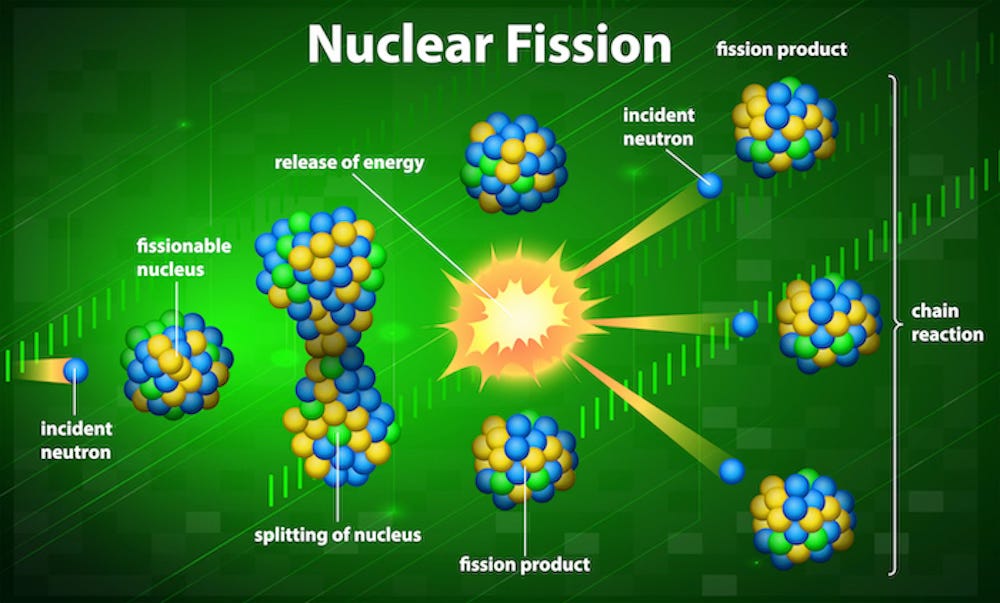
Fissile materials are those that split apart after incorporating a neutron and are capable of sustaining a nuclear reaction. A neutron is a neutrally charged particle that is part of the nucleus of every element in the periodic table except hydrogen (H). Each of these fissions or splits releases smaller elements, more neutrons, radiation, and energy that can be felt as heat.
But not all the neutrons released by the atomic splits are incorporated in other molecules—in this case, plutonium or uranium. Some are lost into the space surrounding the core. THIS IS KEY: So long as the incorporation of the neutrons and the number of splits is kept below a certain level (neutrons “lost” > neutrons released by fission/split reactions), the core material is considered subcritical for a chain reaction event and detonation.
However, once the rate of neutrons released by fission reactions becomes GREATER than neutrons lost to the surroundings, the core becomes supercritical, and a chain reaction of neutron incorporation, fission, radiation, and energy release starts the detonation. The 6.2 kg plutonium/gallium core of Fat Boy exploded with the force of 21 kilotons of TNT. That’s 21 thousand tons or 42 million lbs. I honestly can’t even comprehend what that means.
I mentioned that four atomic cores were created for the Manhattan Project, but only three were detonated. It’s the fourth one that I will link to beryllium. Nicknamed Rufus, it was to be dropped over Tokyo if Japan refused to surrender after Nagasaki. The Japanese surrendered, and the Rufus plutonium/gallium core was moved back into the realm of research at Los Alamos.
There, in short order, it acquired a new name: The Demon Core. Why? Because two of the scientists who used it to examine criticality would end up dead, one of them due to his fatal mistake while wielding a screwdriver and a simple beryllium tamper.
*I would place the discovery of DNA right up there, too. Oh. And fire. Not sure about AI yet.